
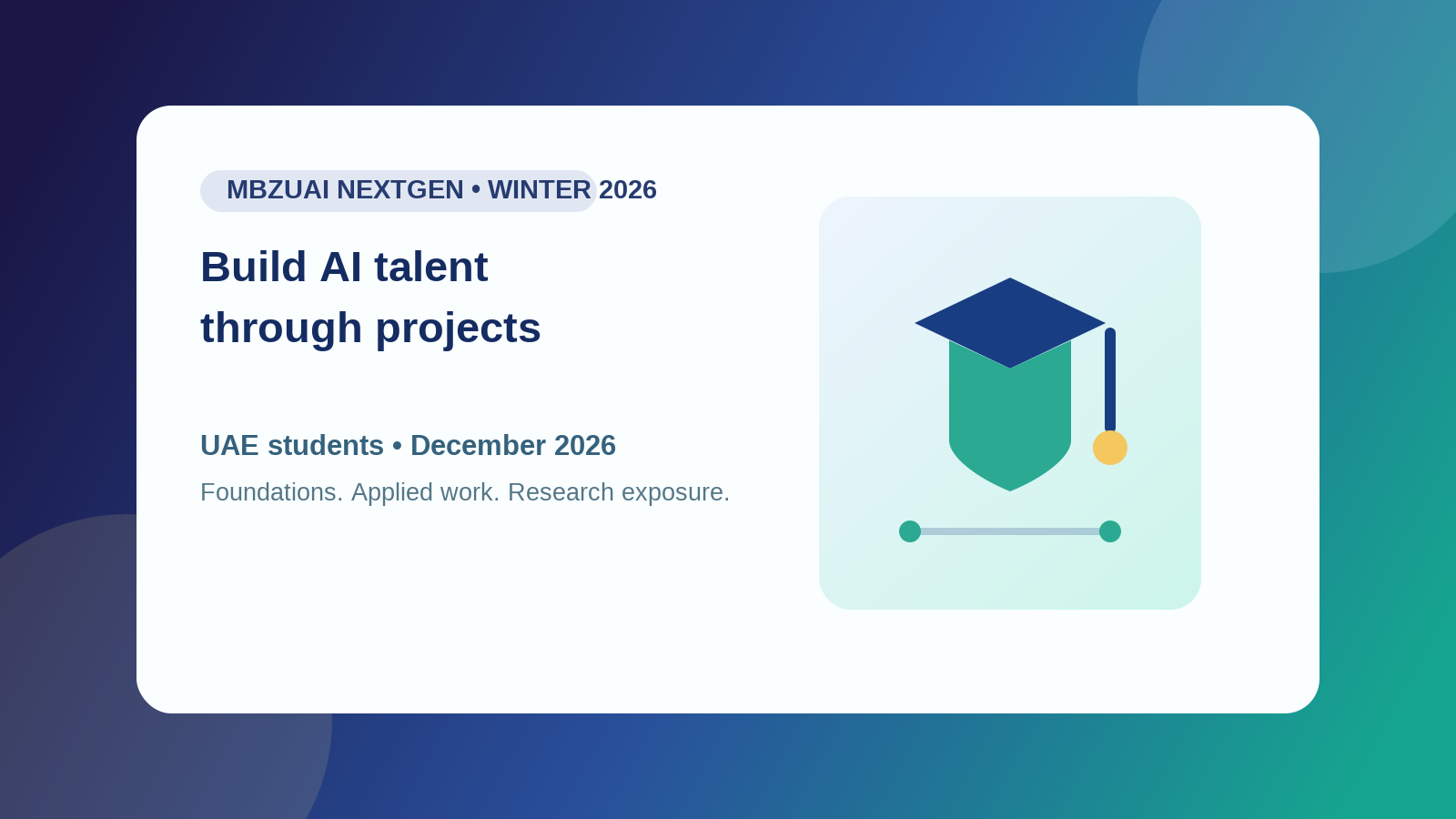
MBZUAI's NextGen Winter Program makes UAE AI talent a project, not a promise
MBZUAI's December 2026 NextGen Winter Program matters because it gives UAE students an applied, early-stage route into AI—linking foundations, projects, and direct exposure to an AI research community.
The UAE's AI ambition will ultimately be constrained less by how many people can describe AI than by how many can work with it carefully: framing a problem, handling data, testing an output, and explaining a result to someone else. That capability starts well before a first job.
The direct answer
Mohamed bin Zayed University of Artificial Intelligence (MBZUAI) is running its NextGen Winter Program for UAE Grade 11–13 students in December 2026. MBZUAI describes it as a 10-day programme that combines academic AI foundations with an applied project and exposure to its research community. It says cohorts will have 45–50 students and be delivered by alumni and graduate students.
This is a talent-development programme, not a professional certification or a guarantee of university admission. Its signal for the UAE AI ecosystem is more practical: it makes project work and research exposure part of the pathway before a student chooses a degree or role.
Why the project matters
Early AI learning can easily become a tools tour: prompt a chatbot, see a result, move on. That builds familiarity, but it does not necessarily build judgment.
An applied project creates a more useful loop:
- Define a problem: identify the user, the decision, and the constraint.
- Work with evidence: decide what data or examples are appropriate and what is missing.
- Build and test: compare a system's output with a clear success measure rather than accepting a persuasive answer.
- Explain limits: state where the approach may fail, who should review it, and what should not be automated.
Those habits transfer across technical and non-technical AI roles. They are also the habits organisations need when a pilot becomes a workflow.
A stronger talent signal than awareness alone
MBZUAI's programme is aimed at secondary-school students who are UAE nationals or residents. By connecting academic preparation to the university's research community, it gives participants a view of AI as a field of inquiry and implementation—not only as a consumer technology.
For employers and education leaders, the useful takeaway is not to expect every participant to become a machine-learning engineer. It is to recognise that a credible AI pipeline needs multiple on-ramps: foundational literacy, applied projects, mentorship, higher education, and eventually work experience.
What schools and families can borrow now
The same structure can make an internal school or youth programme more valuable:
- Set one bounded, locally relevant problem rather than asking learners to "build with AI."
- Require a short evidence log: data sources, assumptions, tests, and unresolved risks.
- Ask for a demonstration and a plain-language explanation, not just a polished slide deck.
- Make review part of the task, especially where a proposal affects people, decisions, or sensitive information.
That approach helps learners understand that AI capability includes responsibility and communication, not just model access.
AiRK view for the UAE market
The encouraging part of a programme like NextGen is its emphasis on foundations plus an applied project. In a fast-moving AI market, durable advantage comes from people who can turn a real problem into a testable, reviewable piece of work.
For UAE organisations planning their future talent strategy, the question is worth asking early: are young learners being rewarded for producing a clever demo, or for showing how they tested it, where it breaks, and how a person remains accountable? The second standard is closer to the capability that responsible AI deployment will require.