
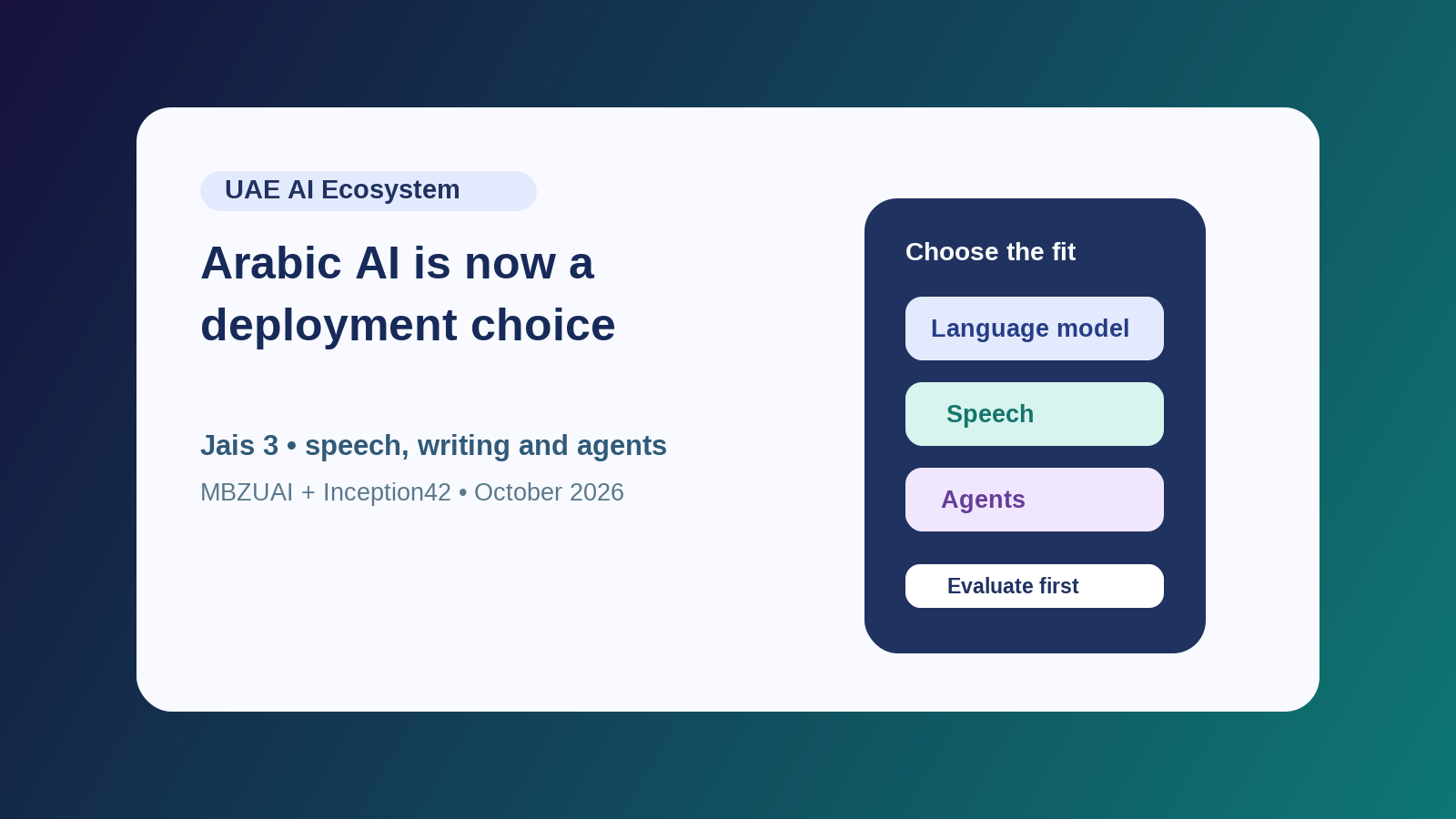
MBZUAI's Jais 3 makes Arabic AI deployment a model-selection decision
MBZUAI and Inception42's Jais 3 release matters because it gives UAE teams an Arabic-native model family spanning speech, writing, and agentic work—while making evaluation and deployment choices more explicit.
Arabic AI deployment is often discussed as a single requirement: does the system support Arabic?
MBZUAI's Jais 3 release makes that question more concrete. The model family spans Arabic speech, writing, and agentic tasks, with multiple sizes intended for different deployment constraints.
The direct answer
On 15 October 2026, MBZUAI's Institute of Foundation Models and Inception42 introduced Jais 3, a family of Arabic-native models built with Cerebras Systems. MBZUAI says the release includes six open language models ranging from 900 million to 375 billion parameters, plus Jais Speech for Arabic and dialect speech recognition.
The announcement matters for UAE teams because it turns Arabic support into a selection and evaluation decision. A team can consider model size, speech requirements, hosting constraints, and task fit rather than treating a generic multilingual model as the default answer.
It is not, however, evidence that any Jais 3 model will be suitable for every production workflow. Organisations still need to test accuracy, safety, privacy, cost, latency, and human handoffs for their own use case.
What MBZUAI says Jais 3 can do
MBZUAI describes Jais 3 as supporting spoken and written Arabic across dialects, Arabic text generation, and practical work such as transcription, document creation, and presentations. The organisation also says the models have a 512,000-token context window and are available on Hugging Face, with deployment support for vLLM and SGLang.
Those details are useful because they separate several implementation choices that can otherwise become blurred:
- a smaller model may fit a constrained or lower-cost workload
- speech recognition is a separate capability to evaluate alongside text quality
- a large context window does not replace retrieval quality, permissions, or source checking
- open availability can expand deployment options, but it also makes operational ownership more important
Why model choice is now part of Arabic AI strategy
For a UAE organisation, language quality is not merely a benchmark number. It affects whether people can use a service naturally, whether a system preserves the meaning of a document, and whether an employee can identify and correct a poor answer.
MBZUAI reports that Jais 3 was trained on Modern Standard Arabic, regional dialects including Emirati and Gulf Arabic, and cultural knowledge relevant to more than 400 million Arabic speakers. That is a meaningful design signal, but it is not a substitute for testing with the Arabic varieties, terminology, and code-switching that occur in a particular organisation.
The right question is therefore not simply, “Which Arabic model scores highest?” It is, “Which model, deployment design, and review process perform acceptably on our real tasks?”
A practical evaluation plan
Teams considering an Arabic-native model can keep the first evaluation narrow and observable:
- Choose one bounded workflow, such as transcribing internal meetings or preparing a draft from approved documents.
- Build a lawful test set that includes the Arabic dialects, English-Arabic switching, names, dates, numbers, and domain vocabulary users actually encounter.
- Define the errors that matter: a mistranscribed name, an unsupported claim, a lost table field, or an unsafe action should not be treated as the same failure.
- Test latency, cost, access controls, logging, and escalation alongside model output quality.
- Keep a person responsible for approval where an output changes a record, communicates externally, or affects a consequential decision.
This is especially important for agentic workflows. A model that can draft Arabic content may still require strict tool permissions and approval gates before it can retrieve sensitive data, create a document, or take action in another system.
What it means for the UAE AI ecosystem
Jais 3 adds a practical building block to the UAE's Arabic AI ecosystem: an openly available model family with choices across scale and modality. The market opportunity is not only the models themselves. It includes evaluation datasets, secure hosting, integration, retrieval design, language-quality review, and the training needed for teams to operate these systems responsibly.
AiRK view for the UAE market
The most useful takeaway from Jais 3 is not that a single model family solves Arabic AI.
It is that UAE teams can now make a more deliberate deployment decision. They can match a model to a bounded job, test it in the language people actually use, and build the controls required for that job before expanding access or autonomy.