
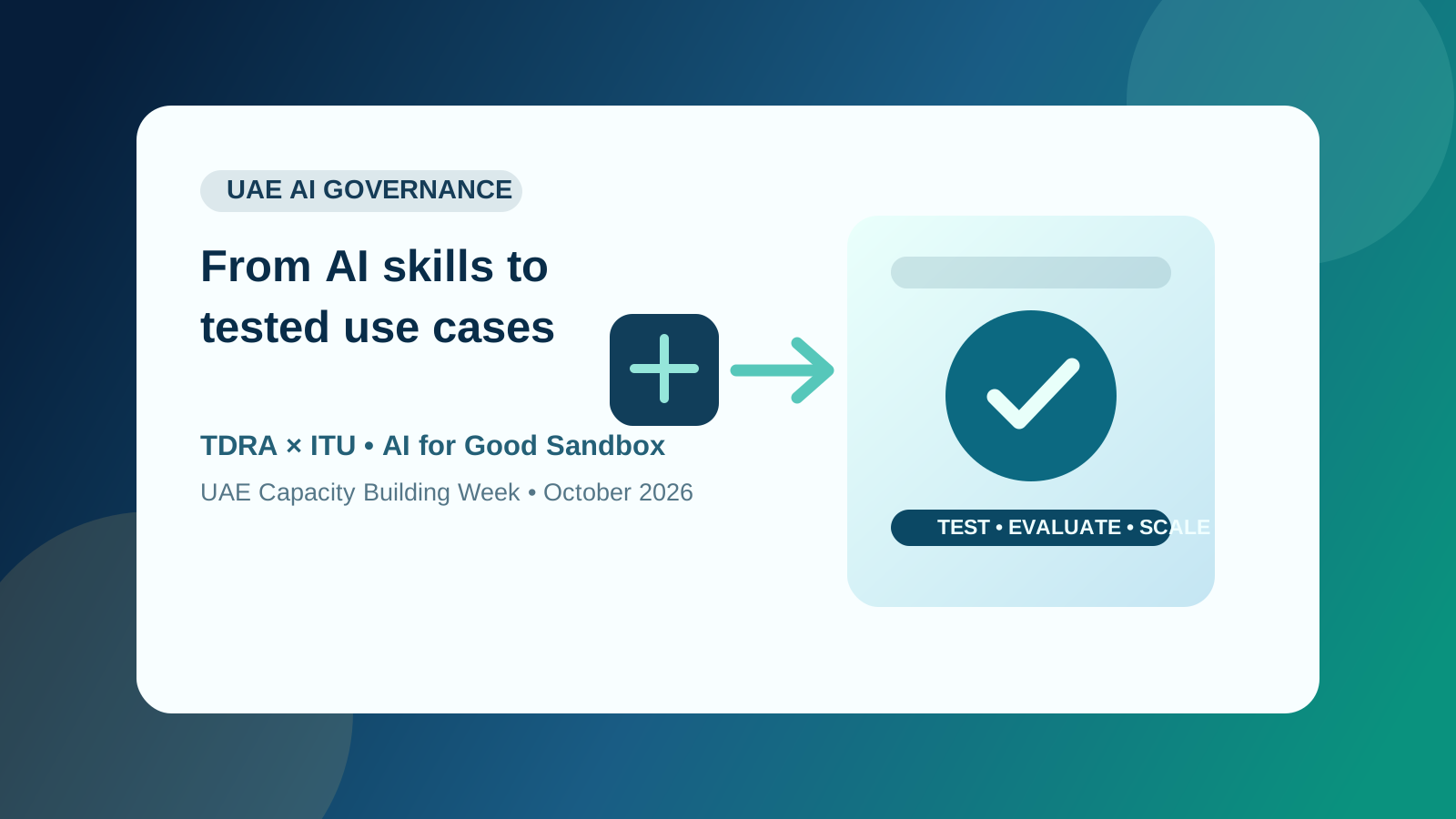
TDRA's AI for Good Sandbox makes UAE AI readiness a testing discipline
TDRA and the ITU's October 2026 capacity-building week matters because it connects AI skills with a sandbox for testing, evaluation, standards, and deployable use cases.
The UAE's next AI challenge is not simply getting more people to try AI tools. It is helping teams turn an idea into a use case that can be tested, evaluated, and governed before it is scaled.
That is the useful signal in the Telecommunications and Digital Government Regulatory Authority's (TDRA) October 2026 AI Capacity Building Week with the International Telecommunication Union (ITU).
The direct answer
TDRA's initiative matters because it joins capability-building with an AI for Good Sandbox: a setting intended to help AI solutions be developed, tested, and evaluated against international standards and best practices before they are treated as deployable systems.
According to TDRA, the week ran from 19 to 22 October 2026 under the theme From Connectivity to Intelligence. It brought together government, academic, startup, and international participants around practical applications, AI policy, governance frameworks, and standards.
The announcement also included an AI for Good Global Hackathon for prototype development in healthcare, education, telecommunications, and government services.
Why a sandbox is more than a training programme
Training can give a team the confidence to identify an AI opportunity. A sandbox can make the next question unavoidable: does that opportunity work safely and usefully in the real operating context?
For an AI use case, that means moving through a deliberate sequence:
- Define the user problem and the decision the system may support.
- Test data quality, permissions, security, and privacy constraints.
- Measure output quality against representative examples and failure cases.
- Set human review, escalation, and incident-response rules.
- Decide whether the evidence is strong enough for a limited deployment.
The value is in the gate between prototype and scale. A polished demonstration does not establish that a system is accurate enough, fair enough, secure enough, or operationally ready for a public or regulated service.
What TDRA has—and has not—announced
TDRA describes the AI for Good Sandbox as a collaborative platform for innovation and experimentation, guided by international standards and best practices. It says the wider partnership is intended to strengthen national AI capabilities and translate knowledge into practical solutions for vital sectors.
Those are ecosystem and readiness objectives. The announcement does not identify a particular system as approved for production, set sector-specific assurance requirements, or establish that hackathon prototypes should be deployed without further validation.
That distinction matters. Sandboxing is an environment for evidence gathering; it is not a shortcut around the governance, procurement, security, accessibility, or domain-review work a live service may require.
A practical model for UAE teams
Teams participating in a sandbox, challenge, or pilot can use the opportunity to produce five concrete artefacts:
- a one-sentence definition of the supported task and the accountable human owner
- a data map covering sources, access, retention, and sensitive information
- a small evaluation set that includes ordinary cases, Arabic or bilingual inputs where relevant, and known edge cases
- pass/fail thresholds and a record of observed failures
- a rollout plan with monitoring, user feedback, and a way to pause the system
These outputs are more durable than a prototype alone. They make it possible for technical, policy, and frontline teams to discuss the same system using evidence rather than general claims about AI capability.
Why this matters for the UAE AI market
The UAE's AI agenda increasingly spans public services, healthcare, education, communications, and industry. Each sector needs people who can do more than prompt a model: they need to scope a use case, evaluate it, recognise limits, and run it responsibly.
TDRA's framing is therefore useful for employers and delivery teams. The scarce capability is not only model building. It is the ability to connect skills, testing, standards, and governance to a specific workflow.
AiRK view for the UAE market
The strongest result from a capacity-building initiative is not a large attendance number or an impressive demo day. It is a portfolio of small, well-evaluated use cases that have clear owners and a credible path to deployment.
The AI for Good Sandbox points toward that discipline. For UAE organisations, the practical next step is to treat experimentation as a structured learning cycle: test a narrow workflow, document what fails, preserve human accountability, and scale only when the evidence supports it.