
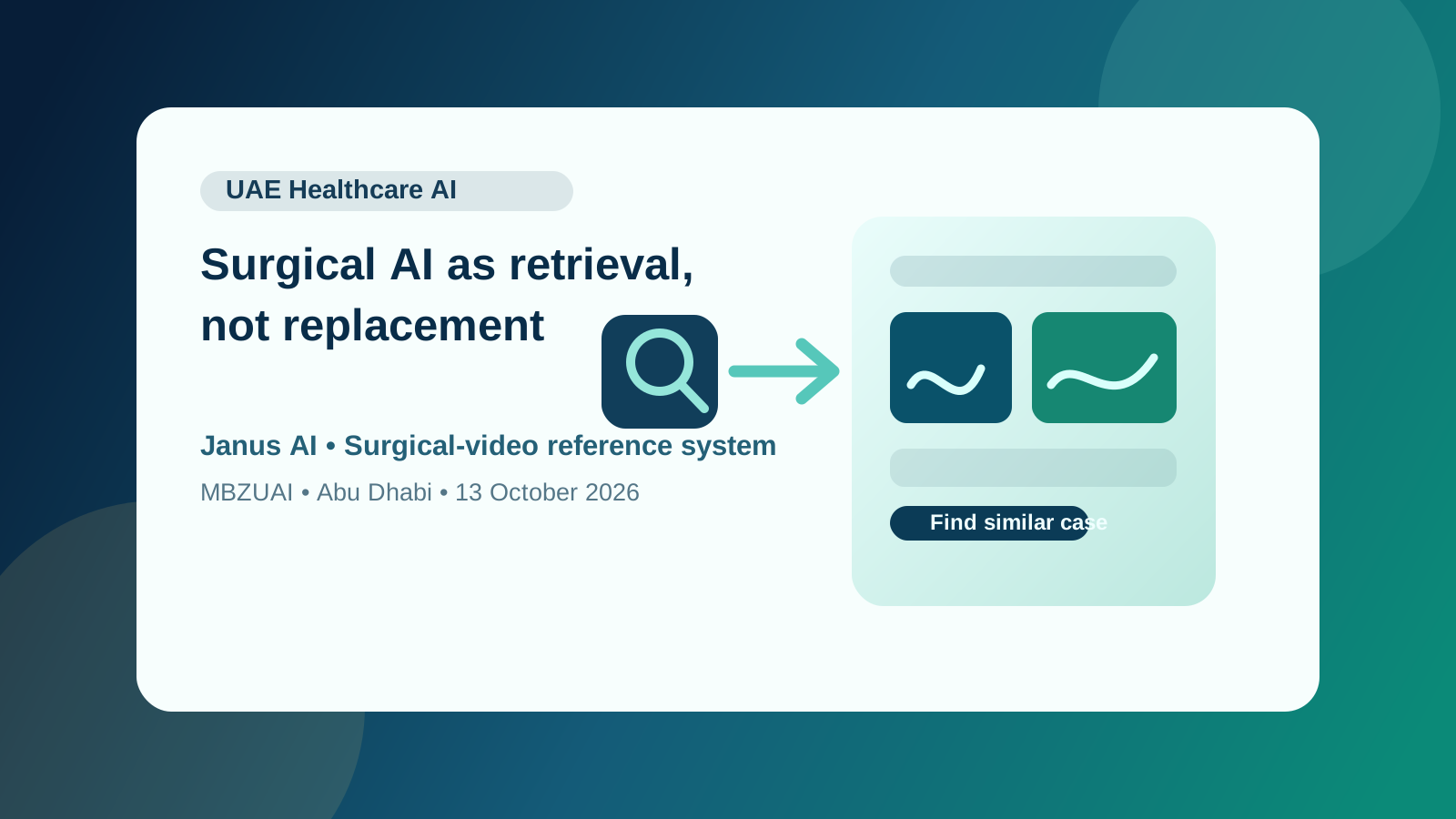
MBZUAI's Janus AI shows what surgical AI looks like before clinical deployment
MBZUAI's 13 October 2026 Janus AI announcement matters because it frames operating-room AI as a retrieval, validation, and workflow-design problem—not an autonomous decision-maker.
Healthcare AI is most useful when the boundary between assistance and decision-making is clear.
MBZUAI's Janus AI project offers a concrete example of that distinction. On 13 October 2026, the university reported that a team led by its researchers won the Robotic Urology Breakthrough Innovation Challenge at ERUS26 for a system that retrieves relevant clips from past robotic surgeries while a surgeon is operating.
The important point is what the system is designed to do: surface comparable reference material. It does not make the clinical decision.
The direct answer
Janus AI matters for the UAE healthcare-AI market because it treats intraoperative AI as an evidence-retrieval workflow with a human clinician in control, rather than presenting it as an autonomous surgical system.
According to MBZUAI, Janus AI matches live operating-room video against a library of 30-second clips from similar procedures. The retrieved clips can then be used as reference material by the surgeon, including by continuing into the full-length recording after a matched segment.
That framing has practical consequences. The hardest work is not only building a model. It is curating appropriate video libraries, measuring retrieval quality, protecting patient data, designing interfaces that do not distract clinicians, and validating the workflow before it reaches patient care.
How the system works, as described by MBZUAI
MBZUAI describes Janus AI as a video-to-video retrieval system.
- A neural network extracts features from clips in the surgical-video library.
- Those library features are precomputed and stored.
- During a procedure, the system processes a current video clip and performs a similarity search over the stored representations.
- MBZUAI says the similarity search runs in RAM and typically takes milliseconds.
This is materially different from a system that generates a diagnosis or instructs a surgeon what to do. Janus AI is intended to find examples that may help a clinician interpret a stage of a procedure or review how a comparable case unfolded.
The distinction matters because a fast retrieval result is not proof that the result is clinically appropriate. A similar-looking clip may still differ in anatomy, patient condition, procedure context, instrumentation, or the judgment required at that moment.
Why this is a workflow problem before it is a model problem
For a hospital or research team, a surgical retrieval system creates several linked requirements:
- Data governance: Determine which recordings may be retained, who can access them, how patients are informed, and how identifying data is protected.
- Clinical curation: Define what counts as a high-quality reference case instead of allowing the system to retrieve any technically similar recording.
- Evaluation: Test whether retrieved videos are relevant, useful, timely, and safe for the intended clinical setting.
- Human factors: Confirm that the interface supports attention and communication in the operating room rather than creating avoidable cognitive load.
- Clinical governance: Establish who owns validation, incident reporting, updates, and the decision to pause or retire the tool.
These are not administrative add-ons. They determine whether a promising retrieval prototype can become a responsible clinical-support product.
What MBZUAI has and has not claimed
The university says the project was developed by MBZUAI with the University of Illinois Chicago and the University of Turin, and that the team plans to expand the library with hundreds of additional surgical videos while advancing validation and clinical translation.
That is an appropriately early-stage description.
The announcement does not claim that Janus AI is cleared for clinical use, that it improves patient outcomes, or that it should replace surgeon judgment. Those would require broader evidence, formal validation, and the approvals applicable to the deployment setting.
For UAE health leaders, that restraint is useful. It makes the right next question less about whether a system is "AI-powered" and more about what evidence is required before it can influence a live clinical workflow.
A practical checklist for UAE teams
Teams considering retrieval or decision-support AI in a regulated care setting can begin with a narrow use case and answer:
- What exact clinical question is the system allowed to support?
- What data is used to build and query the reference library, and where is it stored?
- What happens when the top result is irrelevant, delayed, or unavailable?
- Which clinician remains accountable for the decision at every stage?
- What prospective evidence will be required before any wider deployment?
This approach keeps the technology in a role it can be evaluated for: helping people retrieve evidence and context, while preserving clinical responsibility with qualified professionals.
AiRK view for the UAE market
Janus AI is a useful signal because it makes the path to healthcare AI more concrete. The value is not a dramatic claim of autonomous surgery. It is a disciplined attempt to bring the right prior knowledge into a time-sensitive workflow.
For the UAE, where healthcare AI is increasingly discussed alongside data, genomics, and advanced care, the durable advantage will come from teams that can connect technical capability with clinical validation, privacy, governance, and frontline adoption.
That is the difference between an impressive demo and a system a hospital can responsibly put through clinical translation.