
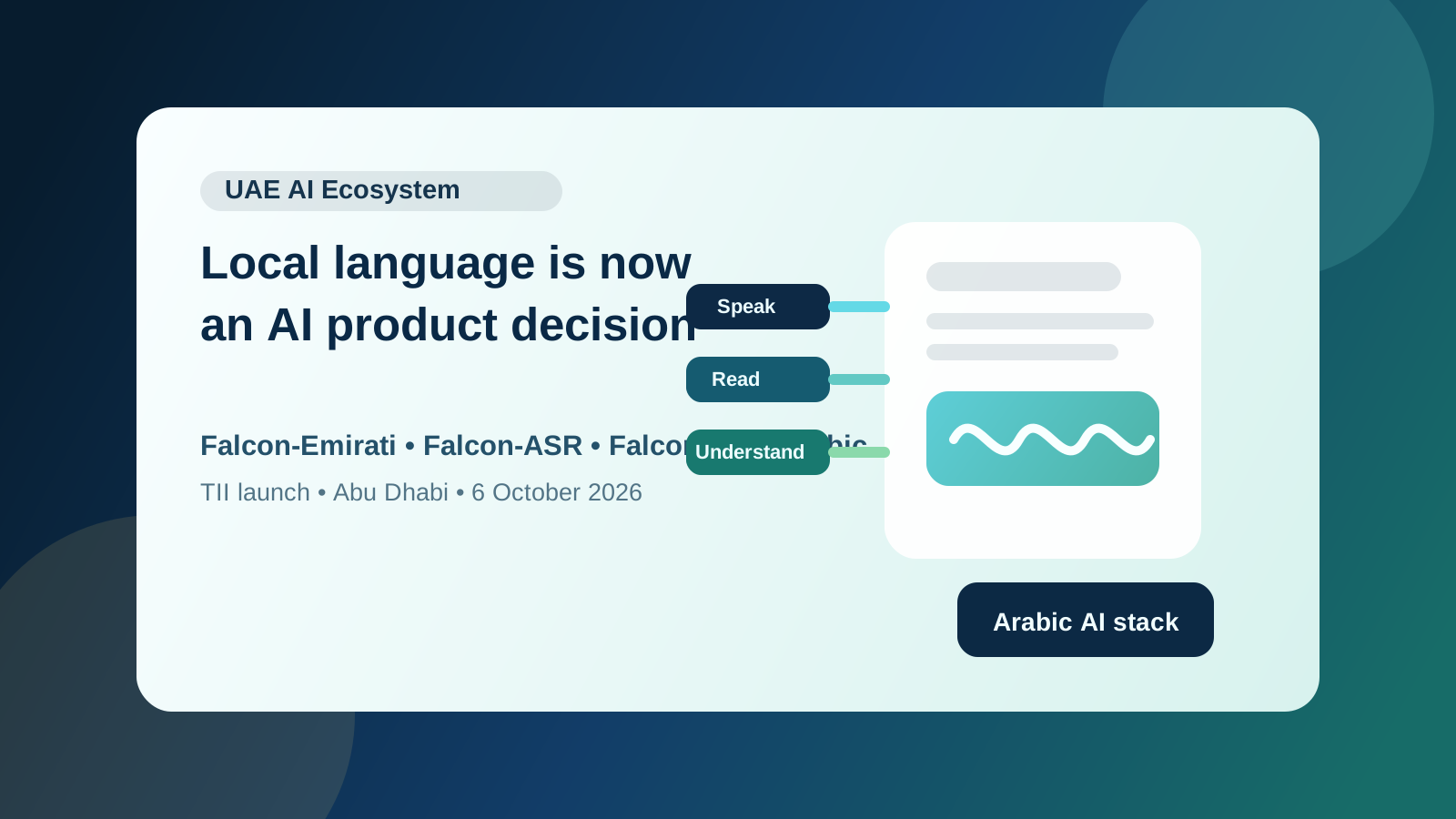
TII's Falcon-Emirati release makes local language a UAE AI product decision
TII's 6 October 2026 Falcon-Emirati launch matters because it treats Emirati Arabic, speech, and Arabic documents as product requirements for AI systems—not edge cases to be handled after deployment.
For UAE teams, Arabic support is often described as a feature.
TII's latest Falcon release suggests a more useful framing:
local language is a product decision
On 6 October 2026, Abu Dhabi's Technology Innovation Institute (TII) launched three models focused on Emirati and Arabic interaction: Falcon-Emirati, Falcon-ASR, and Falcon-OCR-Arabic.
The group matters because it covers three ways people actually encounter AI systems:
- conversational language
- spoken language
- documents and images
The direct answer
The launch matters because it moves Emirati Arabic from an afterthought in an AI workflow to something teams can deliberately build and test for.
According to TII, Falcon-Emirati is a 7-billion-parameter language model designed for Emirati vocabulary, expressions, idioms, and cultural context. It is built on Falcon-H1-Arabic and will be available through Falcon Chat.
TII also launched:
Falcon-ASR, a1.6-billion-parameterspeech-recognition model for Emirati Arabic, Modern Standard Arabic, English, French, Spanish, and PortugueseFalcon-OCR-Arabic, a lightweight model for extracting Arabic text and structured content from images and documents
That does not mean a UAE organisation can adopt any of these models without evaluation, integration work, privacy review, or human oversight.
It does mean the local market now has a clearer prompt: if a service is intended for Emirati users, Arabic speakers, or bilingual teams, language fit should be specified up front.
Why standard Arabic alone is not enough
TII's announcement makes an important distinction.
Modern Standard Arabic is used extensively in formal writing, education, and news. Everyday speech, however, is shaped by regional dialects. The institute says an AI model can recognise the words in an Emirati sentence while still missing its intended meaning, cultural reference, or idiom.
For a UAE customer-service, government-service, or internal-assistant workflow, that gap can show up as more than awkward phrasing.
It can affect:
- whether a user feels understood
- whether a voice or chat interaction needs repeated clarification
- whether a proverb or informal instruction is interpreted safely
- whether a team incorrectly assumes a generic Arabic benchmark represents local performance
The practical lesson is not that every product needs a dedicated Emirati model.
It is that teams should test against the language their users actually use, rather than treating broad Arabic support as proof of local readiness.
What TII actually reported
TII says Falcon-Emirati was developed using native Emirati content, Modern Standard Arabic material about Emirati culture and heritage, and synthetic data informed by Emirati-specific linguistic resources.
The institute reports an 84.83% score on Alyah, a native Emirati Arabic benchmark covering everyday language, figurative expressions, heritage knowledge, and poetry. TII says the model outperformed the Arabic and multilingual open-source models it evaluated.
That is a useful result, but it should be read narrowly.
It supports a claim about the stated benchmark and comparison set. It does not establish that a model will perform equally well on every production task, sector vocabulary, customer demographic, or safety scenario.
For buyers, the right follow-up is an evaluation plan that includes representative local prompts, real documents where lawful, bilingual hand-offs, failure cases, and clear escalation paths for users.
Speech and documents complete the operational picture
Language models alone do not cover most service workflows.
TII says Falcon-ASR can transcribe spoken Emirati Arabic and Modern Standard Arabic, alongside English, French, Spanish, and Portuguese. It also records word-level timing, which TII identifies as useful for subtitling, searchable recordings, and meeting or interview transcription.
Falcon-OCR-Arabic is aimed at extracting Arabic text and structured information from images and documents, including tables, formulas, and document sections.
Together, these releases point to a more complete local-language stack:
speak → transcribe → understand → retrieve → act
That sequence is relevant to contact centres, public services, archives, compliance operations, education, and knowledge-management teams. But every implementation still needs to establish what data may be processed, where it may be hosted, how accuracy will be measured, and when a person must take over.
What UAE teams should do next
This is a good moment to replace generic language requirements with concrete acceptance criteria.
Before selecting a model or vendor, teams can ask:
- Which dialects, registers, and languages will users actually use?
- Do our test sets include Emirati Arabic, informal phrasing, code-switching, and domain terminology?
- Can the system preserve Arabic names, dates, numbers, tables, and document structure accurately?
- Where should the workflow stop and hand a decision to a human?
- How will we monitor language-quality failures after launch?
These questions are more valuable than a broad claim that an AI tool "supports Arabic."
AiRK view for the UAE market
The UAE AI ecosystem has invested heavily in capability, infrastructure, and deployment ambition.
Falcon-Emirati adds a more human requirement to that agenda: the systems need to recognise how people in the UAE communicate in daily life.
For leaders, the signal is not simply that another model has launched.
It is that local-language evaluation, conversational design, document quality, and responsible escalation are becoming part of AI implementation quality. Teams that specify and test those factors early will be in a stronger position than teams that discover them after a public launch.