
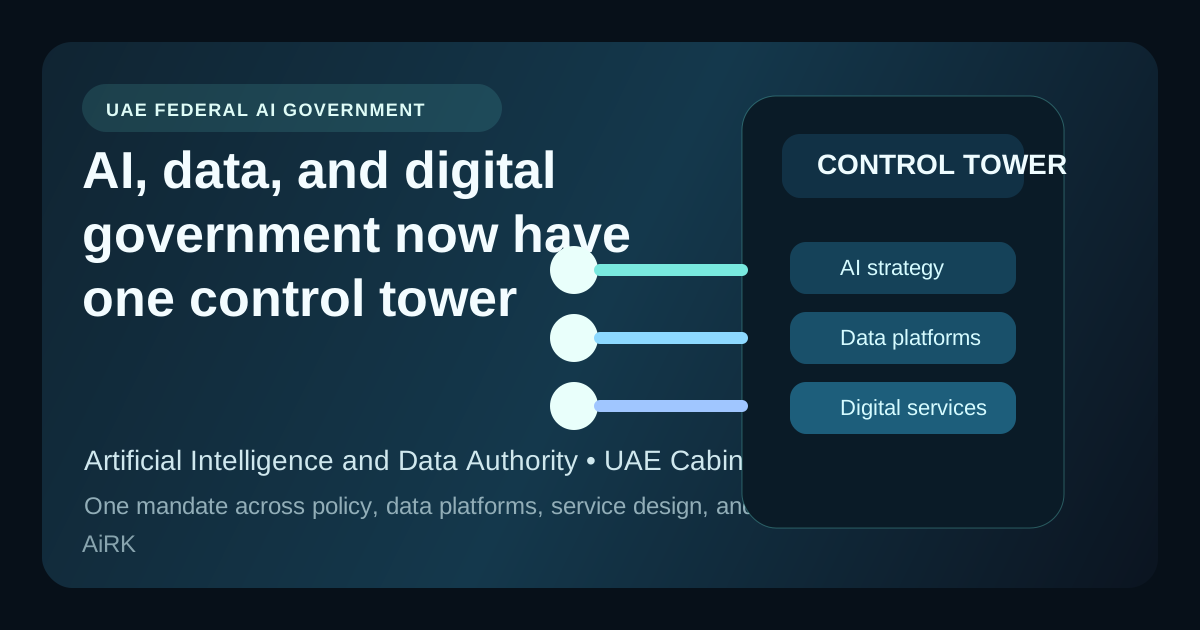
The UAE's new AI and Data Authority shows government AI is becoming a control tower
The UAE's 14 June 2026 creation of the Artificial Intelligence and Data Authority matters because it turns federal AI, data, and digital government into one operating centre with direct Cabinet backing.
The UAE has spent 2026 moving quickly from AI ambition to AI execution inside government.
This update matters because it changes who holds the control layer:
one federal authority
On 14 June 2026, the UAE Cabinet announced the creation of the Artificial Intelligence and Data Authority, a single national body responsible for data, artificial intelligence, and digital government, reporting directly to the Cabinet and chaired by Omar Sultan Al Olama.
That matters because large AI programmes usually slow down when data ownership, digital-service design, policy setting, and implementation oversight sit in separate places.
The UAE is trying to reduce that fragmentation.
The direct answer
The new Authority matters because it turns AI adoption in the UAE federal government into a more centralised operating system.
The strongest signal is not only that a new body exists.
It is that the government has combined three previously separate functions under one mandate:
- the Office of Artificial Intelligence, Digital Economy and Remote Work Applications
- the Digital Government Sector at
TDRA - the UAE Data Office
The practical implication is straightforward:
the UAE is treating AI, data, and digital-service delivery as one execution stack rather than three adjacent agendas
That is a more consequential move than another strategy document.
What the Cabinet actually announced
According to the official UAE Cabinet release, the Authority is responsible for:
- unifying national priorities for a digital government system using
agentic AI - proposing public policies, legislation, and national strategies
- developing and leading the national AI strategy
- managing government data quality, availability, and sharing across federal entities
- operating AI-powered national data platforms for evidence-based decision-making
- overseeing proactive and integrated digital services
- setting standards and compliance requirements for data, AI, and digital transformation
- building national capabilities through research, development, and technical advisory work
That scope matters because it reaches far beyond experimentation.
This is not a lab, a pilot office, or a narrow advisory council.
It is an attempt to create a federal control tower for how AI-enabled government should actually run.
Why the structure is the real story
The UAE had already made its broader direction clear earlier in the year.
On 23 April 2026, the Cabinet announced a framework to transform 50 per cent of government sectors, services, and operations to agentic AI within two years.
On 1 July 2026, the Ministerial Council for Artificial Intelligence and Development reviewed implementation timeframes, execution tracks, and proposed projects tied to that federal transformation.
The 14 June 2026 Authority announcement matters because it adds the missing operating layer between ambition and delivery.
Without a central body, governments often end up with:
- inconsistent data quality across entities
- duplicated digital initiatives
- uneven service standards
- weak accountability for AI deployment
- slower policy-to-implementation translation
The new Authority is designed to tighten those seams.
Why this is bigger than a data-governance update
It would be too narrow to read this as only a data story.
The official mandate explicitly joins:
AI policygovernment datadigital government deliveryservice designcompliancecapability building
That combination suggests the UAE does not want AI to sit as a specialist overlay on top of traditional digital government.
It wants AI to shape how government decisions, service journeys, and shared data infrastructure are organised from the centre.
That is a stronger sign of administrative redesign.
What this means for the UAE AI ecosystem
This is a government announcement, but it has wider market effects.
If federal AI, data, and digital-government decisions are being consolidated, suppliers and implementation partners will face stronger pressure to align with common requirements around:
- interoperability
- security and information governance
- data quality and sharing standards
- service-delivery design
- measurable implementation outcomes
For enterprise teams, this is also a useful market signal.
The UAE federal model increasingly treats AI implementation as something that depends on governance architecture, not just model access or training budgets.
That raises the value of people who can connect policy, data operations, service design, and deployment execution.
Why the timing matters
The Authority was announced in the middle of a year when the UAE had already accelerated:
agentic AIdeployment targets- federal implementation frameworks
- workforce capability programmes
- national service and data standards
Seen in that sequence, the new Authority looks less like a standalone reform and more like an organisational answer to a practical problem:
who coordinates the AI-first state once deployment moves from pilots into system-wide operations?
The UAE's answer is increasingly:
a central body with direct Cabinet backing
What not to overclaim
This announcement does not prove the whole federal stack is now fully integrated.
It does not yet show:
- how quickly every entity will align with the new operating model
- what conflicts will arise between central standards and local execution realities
- which performance metrics the Authority will use to judge success
- how much implementation speed will improve in practice
So the disciplined conclusion should stay narrower.
The important signal is that the UAE has created a single federal authority to govern the overlap between AI, data, and digital government at a moment when agentic AI deployment is becoming an execution priority.
AiRK view for the UAE market
The Artificial Intelligence and Data Authority matters because it gives the UAE federal AI agenda a clearer command structure.
The strongest takeaway is not only that the country wants more AI in government.
It is that the UAE now wants a single body to coordinate the data, service, policy, and execution layers needed to make that ambition operational.
For leaders, operators, and workforce builders, that is a sign that UAE government AI is becoming less of a portfolio of projects and more of a centrally managed operating model.
Sources
- UAE Cabinet: Mohammed bin Rashid approves establishing Artificial Intelligence and Data Authority
- UAE Cabinet: Chaired by Mansour bin Zayed, Ministerial Council for Artificial Intelligence and Development reviews plans, projects on transformation to adopting Agentic AI in Federal government operations
- UAE Cabinet: Under directives of UAE President and in world first: Mohammed bin Rashid reveals new UAE government framework to deploy Agentic AI across 50% of government sectors, operations within two years