
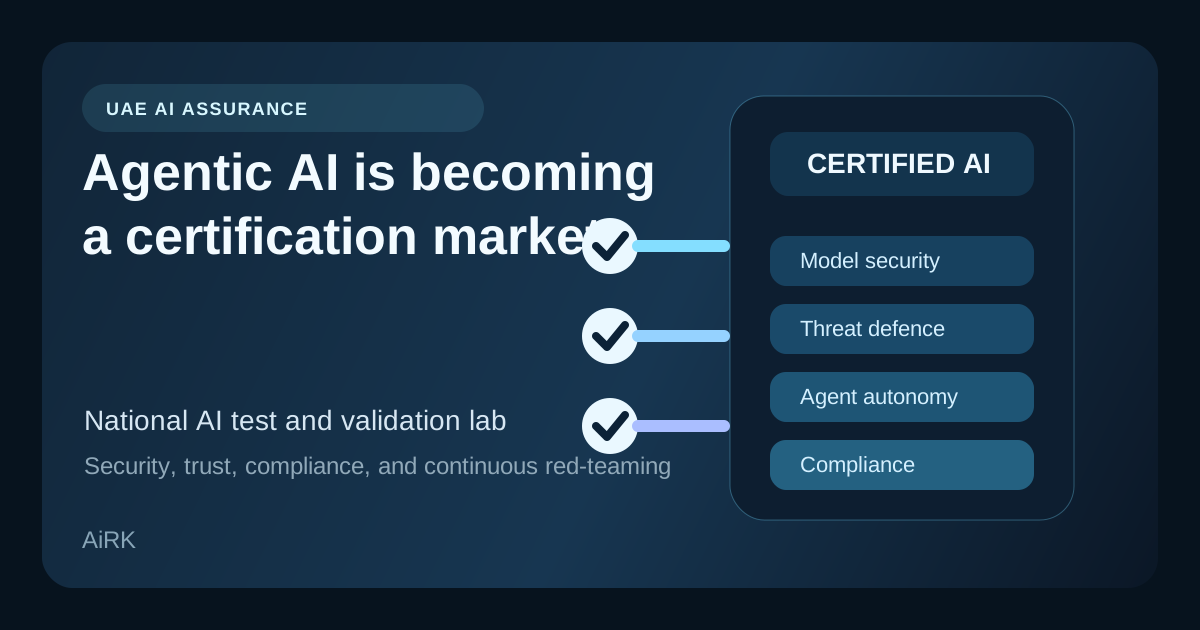
The UAE's AI test-and-validation lab shows agentic AI is becoming a certification market
The UAE Cyber Security Council's National AI Test and Validation Lab matters because it moves secure AI adoption from broad governance language into a certifiable operating layer for models, agents, and applications.
The UAE has spent much of 2026 pushing AI from experimentation into operating infrastructure.
This update matters because it adds another missing layer:
technical assurance
On 4 May 2026, the UAE Cyber Security Council, Cisco, and Open Innovation AI announced the National AI Test and Validation Lab, a facility designed to test, validate, and certify AI models, agents, and applications against UAE cybersecurity policies and international standards.
That matters because large-scale AI adoption does not only depend on model access or deployment speed.
It also depends on whether organisations can prove that the systems they deploy are safe enough, secure enough, and governed well enough to be trusted.
The direct answer
The National AI Test and Validation Lab matters because it turns AI assurance into an explicit market function in the UAE.
Instead of leaving trust, safety, and security as abstract governance goals, the lab creates a mechanism to:
- evaluate models, agents, and applications before or during deployment
- test them against known attack patterns and operational risks
- check alignment with UAE cybersecurity requirements
- issue a national certification mark for systems that pass
The practical implication is straightforward:
the UAE is starting to treat AI assurance as production infrastructure, not as a side discussion after deployment
That is a stronger market signal than another broad statement about responsible AI.
What was actually announced
According to the official WAM report and the matching Open Innovation AI release, the lab is hosted in the UAE and operates under the governance of the UAE Cyber Security Council.
The stated purpose is to help government entities, critical-infrastructure operators, regulated sectors, and UAE-based AI developers assess whether their systems are secure, trustworthy, and aligned with both national and international requirements.
The sources say the lab evaluates AI systems across six areas:
- model security
- threat defence, including prompt-injection and jailbreak risks
- data integrity and privacy leakage
- supply-chain security for models and weights
- agent autonomy and tool-use risk
- regulatory compliance with UAE AI, cloud, and cybersecurity mandates
That list matters because it reflects the actual failure points that become more serious once AI systems move into production workflows.
This is not a lightweight policy checklist.
It is a technical and operational control layer.
Why the certification angle is the real story
The most important part of the announcement is not the word lab.
It is the idea of a national certification mark.
That changes the conversation.
Many organisations still treat AI governance as internal policy, vendor questionnaires, or legal review. Those things matter, but they often stop short of continuous technical testing.
The UAE's new lab points toward a harder standard:
- models and agents should be red-teamed
- evidence should be collected systematically
- policy conformance should be checked technically
- trust should be demonstrated, not just claimed
That matters especially in an agentic AI environment, where systems are not only generating text but also taking actions, calling tools, and interacting with sensitive workflows.
As AI agents become more autonomous, the cost of weak validation rises.
So the market starts rewarding people who can certify behaviour, not only build capability.
Why this is distinct from the UAE's broader sovereign AI story
The UAE has already produced several 2026 announcements around sovereign AI platforms, secure infrastructure, and AI-native government ambitions.
This announcement adds a different layer.
Infrastructure answers the question:
where and under whose control does AI run?
The test-and-validation lab answers another:
how do we verify that the AI system itself is safe and fit for deployment?
That distinction matters.
You can host an AI system in a sovereign environment and still have problems with prompt injection, unsafe agent behaviour, weak model governance, or poor supply-chain integrity.
This lab addresses those risks more directly.
That is why the announcement is better read as an assurance story than as another infrastructure story.
What this means for the UAE AI market
For the wider UAE ecosystem, this development suggests that AI deployment standards are tightening.
If a national facility is already operational and expected to scale to analyse tens of thousands of AI agents annually, several market effects follow.
Government entities and regulated operators will face more pressure to show evidence of secure deployment.
Vendors and AI developers will face stronger expectations around testing, documentation, model provenance, and runtime controls.
Enterprise buyers will have a clearer reason to ask not only "what can your agent do?" but also "how has it been validated?"
The next competitive edge will not come only from better demos.
It will come from a stronger ability to move AI through assurance gates without stalling deployment.
What professionals and teams should notice
This also matters for workforce planning.
The UAE market increasingly needs people who can connect AI implementation with assurance disciplines such as:
- red-teaming and adversarial testing
- AI risk classification
- model and data lineage review
- policy and control mapping
- human oversight design for agent workflows
- deployment approval and escalation processes
That need reaches beyond cybersecurity teams.
It affects digital transformation leaders, procurement teams, product owners, compliance functions, public-sector operators, and enterprise implementation teams.
In other words, as the UAE AI market matures, AI governance literacy becomes more valuable when it is tied to actual system validation.
What not to overclaim
This announcement does not prove that every major UAE AI deployment will now be certified before launch.
It does not yet show:
- which entities are already using the lab at scale
- how certification thresholds will evolve by sector or risk level
- whether the process will become mandatory in some domains
- how quickly private-sector developers will adapt their workflows to fit this model
So the disciplined conclusion should stay narrower.
The important signal is that the UAE has created technical infrastructure for testing and certifying AI systems, which moves the market beyond general trust language and closer to operational assurance.
AiRK view for the UAE market
The National AI Test and Validation Lab matters because it gives the UAE AI ecosystem a more concrete answer to a serious deployment question:
how do we trust an AI system before it touches sensitive work?
That makes this a meaningful market development. It suggests the UAE wants AI leadership to depend not only on adoption speed or infrastructure ownership, but also on the ability to verify models, agents, and applications against real technical and governance standards.
For leaders, operators, and workforce builders, that means the next AI advantage may come from assurance readiness, not just implementation readiness.
Sources
- Emirates News Agency: UAE Cyber Security Council, Cisco, Open Innovation AI establish national AI test, validation lab
- Open Innovation AI: UAE Cyber Security Council, Cisco and Open Innovation AI Establish National AI Test and Validation Lab
- UAE Cyber Security Council: National Cloud Security Policy