
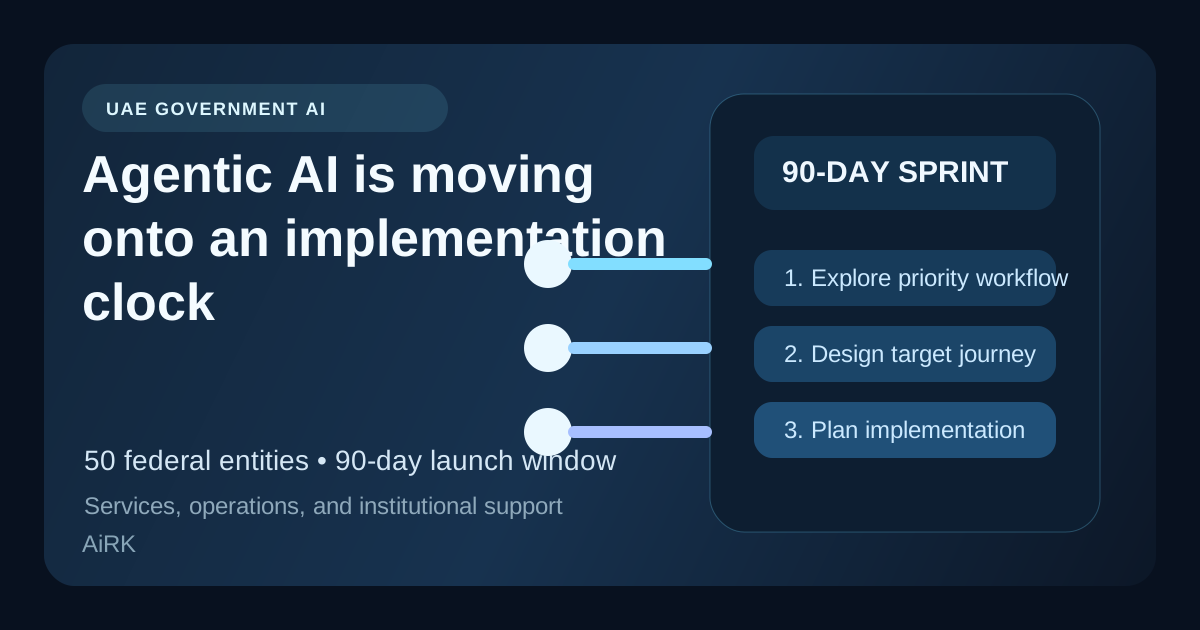
The UAE's 90-day agentic AI sprint shows government AI is moving onto an implementation clock
The UAE Government's July 29, 2026 agentic AI workshop matters because it turns a two-year national target into a 90-day implementation schedule across 50 federal entities.
The UAE has spent much of 2026 making agentic AI a government priority.
This update matters because it adds a harder constraint:
time-bound execution
On 29 July 2026, WAM reported that the UAE Government held a specialised agentic AI workshop with more than 300 participants from 50 federal entities, with each entity required to select a service or operation for implementation within 90 days.
That matters because national targets are one thing.
Implementation clocks are another.
The direct answer
The workshop matters because it shifts the UAE's federal agentic AI agenda from strategic intent into a monitored delivery cycle.
The key signal is not only that the government wants 50 per cent of sectors, services, and operations moved toward agentic AI models within two years.
It is that the government has now started forcing entities to:
- choose a specific service or operation
- map the current workflow
- design the target journey
- define implementation requirements
- launch within a
90-daywindow
The practical implication is straightforward:
the UAE is treating agentic AI as an operating programme with deadlines, not as a general innovation theme
That is a stronger ecosystem signal than another strategy announcement.
What the government actually announced
According to the 29 July 2026 WAM report, the workshop was organised by the Ministry of Cabinet Affairs and structured around the rollout of the UAE's new government system for agentic AI.
The release says the framework covers three tracks:
- government services
- government operations
- institutional support
It also says each participating entity is expected to complete implementation planning across three phases:
- exploration
- design
- implementation planning
The same report says progress will be monitored over a three-month period to ensure the selected services and operations are launched within the defined timeframe.
That detail matters.
It shows the UAE is not only publishing a target and leaving entities to interpret it loosely.
It is imposing a delivery cadence.
Why the 90-day structure is the real story
The UAE's April and May announcements already made the strategic direction clear.
On 23 April 2026, the UAE Cabinet said it aimed to transform 50 per cent of government sectors, services, and operations within two years using agentic AI models.
On 18 May 2026, the Cabinet approved the federal implementation framework and a capability-building programme designed to train 80,000 federal employees across five occupational categories.
Those announcements established ambition and governance.
The 29 July 2026 workshop adds something more operational:
an implementation rhythm
That matters because large AI programmes often fail in the gap between national aspiration and workflow-level execution.
By requiring ministries and entities to pick named processes, assess readiness, and move through a short implementation cycle, the UAE is narrowing that gap.
What the workshop focused on
The official WAM report gives a useful picture of what the government considers priority operational domains.
In the operations and institutional-support track, participants examined areas including:
- human resources
- procurement and contracts
- financial and administrative affairs
- legislative affairs
- internal audit
- digital transformation and technical support
- institutional communication and media
- facilities management and maintenance
That list matters because it suggests the UAE is not limiting agentic AI to public-facing chat interfaces.
It is also targeting the back-office machinery of government.
That is usually where productivity gains, governance questions, and organisational resistance become most real.
Why this matters for the wider UAE AI market
This is a government story, but it also has market implications.
If federal entities are now being asked to launch agentic AI implementations on a 90-day schedule, the surrounding market will face stronger pressure to provide:
- clearer workflow design
- better process documentation
- stronger data readiness
- more disciplined governance controls
- faster deployment support
That raises the bar for vendors, systems integrators, internal digital teams, and training providers.
The winning capability will not be generic AI enthusiasm.
It will be the ability to convert a messy government or enterprise process into a governed automation journey that can survive scrutiny on speed, quality, and accountability.
Why this also aligns with the UAE's broader agentic stack
The workshop does not sit in isolation.
It lands alongside a broader 2026 UAE pattern in which agentic AI is being tied to:
- federal implementation frameworks
- workforce capability-building
- awards and benchmarking
- enterprise and sovereign-platform partnerships
One recent example is the Inception42 and Microsoft collaboration announced on 28 July 2026, which was framed around helping governments and enterprises move from fragmented deployments toward governed agent ecosystems with in-country data processing.
That does not prove immediate success at scale.
But it does suggest the UAE ecosystem is trying to align policy, workforce, and platform layers at the same time.
What not to overclaim
This workshop does not prove that the federal agentic AI project has already succeeded.
It does not yet show:
- which entities will ship the strongest use cases
- how many of the selected services will reach production on time
- what measurable savings or service improvements will result
- how governance, auditability, and escalation will work in practice across every domain
So the disciplined conclusion should stay narrower.
The important signal is that the UAE has now put parts of its agentic AI agenda onto a real implementation clock.
That is different from proving that every ministry is already operating at scale with reliable agents.
AiRK view for the UAE market
The UAE's 29 July 2026 workshop matters because it makes the country's agentic AI push more operational.
The strongest signal is not the headline target alone. It is the requirement for entities to choose workflows, design target journeys, and launch inside 90 days under central monitoring.
For government teams, enterprise operators, and AI implementation partners, that means the market is moving beyond AI positioning and into execution discipline.
Sources
- Emirates News Agency: UAE Government holds agentic AI workshop with participation of 50 federal entities
- Emirates News Agency: Under directives of UAE President and in world first: Mohammed bin Rashid reveals new UAE government framework to deploy Agentic AI across 50% of government sectors, operations within two years
- Dubai Media Office: UAE Cabinet, chaired by Mohammed bin Rashid, approves federal framework for Agentic AI Project implementation
- Emirates News Agency: Inception42, Microsoft move agentic AI from pilots to government, enterprise operations