
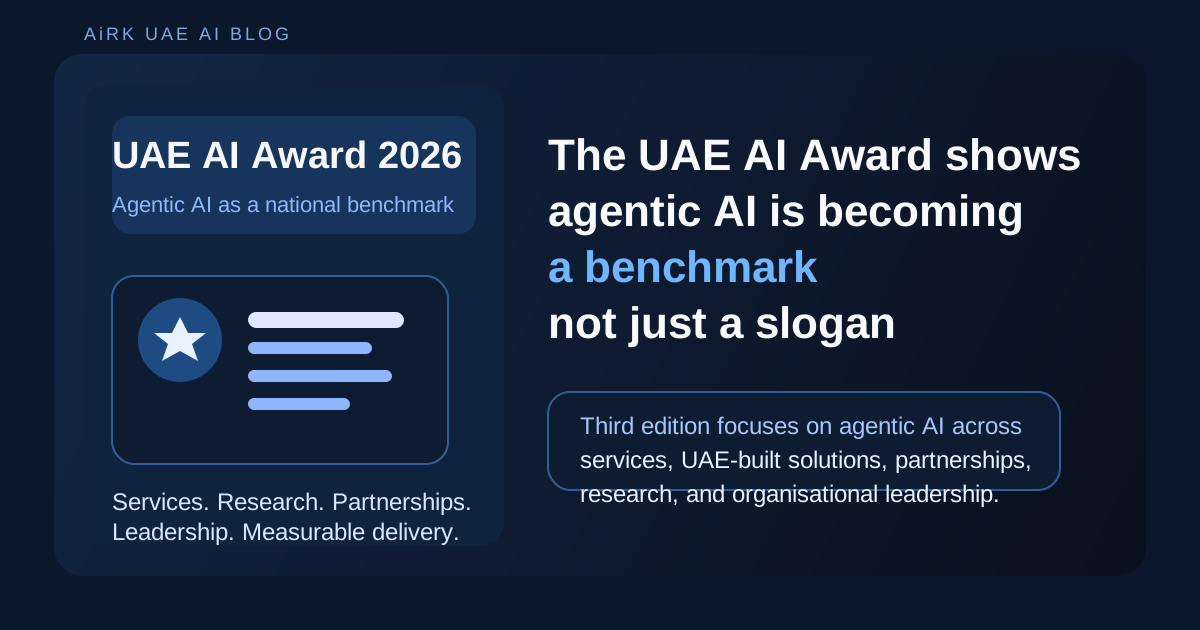
The UAE AI Award shows agentic AI is becoming a benchmark, not just a slogan
The UAE AI Award's third edition matters because it turns the country's agentic AI push into a more measurable benchmark for government entities, researchers, companies, and leaders rather than leaving it at the level of strategy language.
The UAE has spent much of 2026 pushing agentic AI from concept into government operating design.
This update matters because it adds a missing piece:
measurement
On 28 July 2026, WAM reported that the UAE Council for Artificial Intelligence and Blockchain launched the third edition of the UAE AI Award, this time with an explicit focus on Agentic AI.
That matters because awards are not the point.
The point is what the award is measuring, rewarding, and normalising.
The direct answer
The third UAE AI Award matters because it turns agentic AI into a more concrete national benchmark.
Instead of only talking about adoption in broad terms, the award creates visible categories for:
- agentic AI-powered services
- UAE-developed agentic AI solutions
- government-private partnerships
- scientific research
- leadership in AI adoption
The practical implication is straightforward:
the UAE is starting to define what good agentic AI execution should look like across institutions, not only what good AI ambition sounds like
That is a stronger market signal than another generic policy statement.
What the UAE actually announced
According to the WAM announcement, the third edition of the UAE AI Award is designed to advance excellence and innovation in the adoption of Agentic AI while recognising entities and individuals using these systems to improve government performance, services, and community outcomes.
The release says the award now centres on five categories:
Excellence in Agentic AI-Powered ServicesAgentic AI Solutions Developed in the UAEBest Government-Private Partnership in Agentic AIAgentic AI Scientific ResearchAI Leader
That structure matters.
It shows the UAE is not treating agentic AI as one narrow software category.
It is treating it as an ecosystem category spanning service delivery, domestic product-building, partnerships, research, and institutional leadership.
The announcement also says the first two editions together attracted more than 540 applications.
That is useful context because it suggests the award is not being launched into a vacuum. There is already enough activity in the market for the government to formalise a stricter benchmark.
Why this matters in the context of the UAE's 2026 agentic AI push
This award is more important when read alongside the UAE Cabinet's 18 May 2026 federal framework for implementing the Agentic AI Project.
In that Cabinet update, the government said it aims to transition 50 per cent of federal government services and operations to agentic AI models within two years, while also training 80,000 federal employees across leadership, technical, specialist, general workforce, and train-the-trainer tracks.
That means the UAE now has at least three visible layers in its 2026 agentic AI agenda:
- a national transformation target
- a national capability-building programme
- a national recognition framework for what strong implementation looks like
That third layer matters more than it first appears.
Targets create pressure.
Training builds supply.
But recognition frameworks help define which kinds of outcomes count as serious progress.
Why this is a benchmark story, not an awards story
It would be easy to dismiss this as branding.
That would be too shallow.
Awards often matter less for ceremony than for the evaluation logic behind them.
The categories in this edition signal that the UAE wants agentic AI judged through practical evidence such as:
- whether services become more effective
- whether local teams are building usable solutions
- whether partnerships are producing real delivery
- whether research is contributing to deployment, not only theory
- whether leaders are building adoption capacity inside organisations
That pushes the market toward execution quality.
For government teams, it raises the bar from "we are exploring AI" to "we can show service impact, governance discipline, and implementation outcomes."
For private companies, it raises the value of products and partnerships that can survive public-sector scrutiny.
For researchers, it suggests that applied relevance and translational value may matter more than isolated novelty.
What professionals and organisations should notice
For the UAE AI market, the useful lesson is that agentic AI is becoming a performance category.
That changes what different actors should optimise for.
Government entities will need stronger evidence that agentic systems improve service delivery and operations responsibly.
Private firms will need clearer case studies, governance controls, and public-sector integration discipline.
Universities and labs will face more pressure to connect research with deployable value.
Leaders will increasingly be judged not on whether they mention AI, but on whether they can sponsor measurable organisational adoption.
That is a more mature phase of market development.
What not to overclaim
This announcement does not prove that the UAE has already solved large-scale agentic AI deployment.
It does not show:
- how submissions will be evaluated in practice
- which sectors are currently strongest
- whether award-winning use cases will generalise across entities
- how much of the activity is still at pilot stage
So the disciplined conclusion should stay narrower.
The significance of this award is that the UAE is beginning to formalise what counts as credible agentic AI progress. That is different from proving that the whole market has already matured.
AiRK view for the UAE market
The next stage of the UAE AI market will not be shaped only by who has access to tools.
It will be shaped by who can demonstrate governed, measurable, institution-ready outcomes.
The third UAE AI Award matters because it helps codify that shift. It suggests the country is moving from agentic AI as aspiration toward agentic AI as benchmark, with implications for public-sector operators, enterprise partners, researchers, and workforce-development providers alike.