
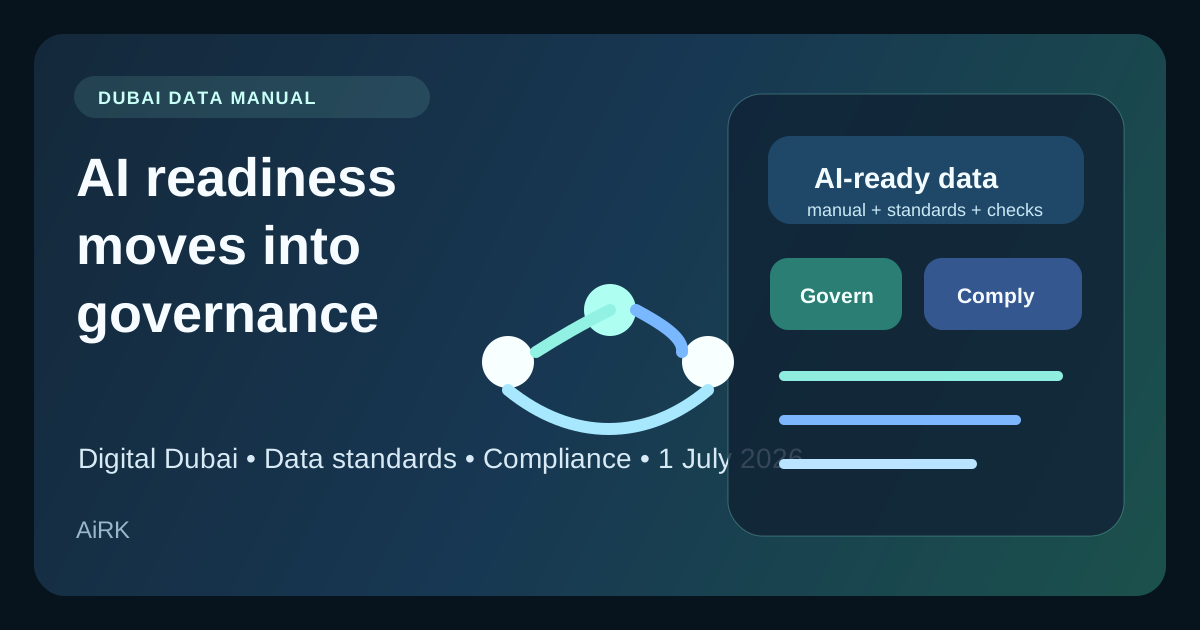
Dubai's updated Data Manual shows AI readiness is becoming a governance market
Digital Dubai's 1 July 2026 update to the Dubai Data Manual matters because it turns AI readiness from a vague aspiration into a government-wide data governance discipline built around standards, compliance, and implementation capacity.
Dubai talks about AI often.
This update explains what serious AI adoption actually depends on.
On 1 July 2026, Digital Dubai said the Dubai Data and Statistics Establishment had launched an updated Dubai Data Manual to help government entities govern, manage, share, and maximise data in line with international practices and the Dubai Data Law.
That matters because it reframes AI readiness in a more practical way.
The useful signal is not that Dubai wants more AI.
It is that Dubai is putting more structure around the data quality, governance, roles, compliance, and AI-ready environments that real deployment requires.
The direct answer
This development matters because it pushes Dubai's AI agenda deeper into operating discipline.
According to the official announcement, the updated Manual:
- combines mandatory standards with practical implementation guidance
- covers data quality, governance, compliance, and roles
- expands the scope of
AI readiness - is designed to help entities move from fragmented practices toward a unified government-wide approach
The practical implication is straightforward:
Dubai is treating AI readiness less as a model-access problem and more as a data-governance execution problem
That is a stronger market signal than another generic AI adoption statement.
What Digital Dubai actually announced
The official release is explicit about the logic.
Digital Dubai says the updated Manual is meant to help entities build accurate, real-time, consistent, structured, and AI-ready data environments. It also says the new edition aligns with a broader Digital Dubai strategy built around integrated city-wide digital experiences, product-based operating models, demand-driven data ecosystems, and stronger compliance with the Dubai Data Law.
That combination matters.
It suggests Dubai is not only asking government teams to use AI tools. It is asking them to standardise the information environments those tools depend on.
The release also says the updated edition introduces:
- a unified structure across organisational units
- a more integrated data framework
- mandatory data standards
- self-assessment checklists
- stronger alignment with international best practices
That is a practical implementation stack.
This is what mature institutional AI work usually looks like before the visible applications scale: less attention on demos, more attention on data definitions, ownership, quality controls, and consistency across entities.
Why this matters more than a normal data-policy update
It would be easy to misread this as a technical housekeeping story.
That would be too shallow.
The official announcement directly ties the Manual to AI applications and future government readiness. H.E. Younus Al Nasser says the quality, governance, and readiness of data will define the strength of Dubai's digital future, and the release says the Manual is intended to help entities deliver better decisions, better services, and better customer experiences through trusted data.
That changes the meaning of the update.
The real signal is not only that another guidance document exists.
The real signal is that Dubai is building the conditions under which AI can be deployed across government with more consistency and less improvisation.
In practice, that affects questions such as:
- whether two entities define the same field in the same way
- whether data can be exchanged reliably
- whether compliance requirements are clear before deployment starts
- whether teams can trust data enough to automate around it
- whether AI outputs can be grounded in structured, current information instead of ad hoc documents and inconsistent records
Those are not side issues.
They are often the difference between AI theatre and durable implementation.
Why the older Dubai data agenda matters here
This July 2026 update is easier to understand when placed inside Dubai's longer official data agenda.
In an October 2025 Digital Dubai recap of the city's data journey, the organisation said Dubai's path began with the 2015 Dubai Data Law, followed by the 2017 Open Data Policy, 2019 AI Ethics Principles and Guidelines, and a 2022 Synthetic Data Framework.
That historical sequence matters because it shows the new Data Manual is not an isolated publication.
It looks more like the next operational layer in a longer governance buildout:
- first, create a legal basis for data sharing
- then create broader policy and ethics frameworks
- then expand privacy-preserving and advanced-data capabilities
- then make implementation requirements clearer for entities expected to run AI-enabled services
The disciplined reading is:
Dubai is tightening the institutional plumbing behind AI, not only promoting AI use cases at the surface
Why standardisation is a market signal
One of the easier mistakes in AI analysis is to assume that infrastructure means only chips, clouds, and data centres.
For government and large enterprises, standardisation is also infrastructure.
Digital Dubai's own knowledge-hub material on data standardisation already framed the issue clearly in October 2023: government forms and systems need consistent data-entry requirements so data is accurate, consistent, and compliant with the Dubai Data Law.
That older guidebook matters because it shows the latest Manual is building on a pre-existing standardisation effort rather than inventing one from scratch.
For the Dubai AI market, that has practical consequences.
It raises the value of teams that can:
- map data flows across departments
- clean up inconsistent field definitions
- connect compliance requirements to workflow design
- prepare operational data for analytics and AI use
- decide which processes are ready for automation and which are not
That is not glamorous work.
It is also exactly the kind of work that determines whether AI systems survive contact with real institutions.
What this means for Dubai's government AI model
The update also fits the wider direction visible in other Dubai government work this year.
Earlier in 2026, Digital Dubai published the AI Integration Matrix Framework and launched the AI+ workforce programme. Those moves focused on use-case structure and workforce readiness.
This Data Manual update adds another layer: data discipline.
Together, those signals suggest Dubai's government AI model is becoming more complete:
- workforce readiness
- use-case prioritisation
- governance structure
- data standardisation
- compliance and implementation guidance
That is a stronger system than a simple train-and-deploy approach.
It also makes Dubai more legible as a market.
Vendors, implementation partners, and public-sector teams can infer that future AI work will likely be judged not only on novelty, but also on whether it fits a governed data environment.
What professionals and companies should notice
For UAE professionals, this announcement is a reminder that the market is moving toward AI operations, not only AI familiarity.
The useful capability is increasingly the ability to connect:
- service design
- data governance
- compliance requirements
- automation decisions
- measurable operational outcomes
For companies selling into government or regulated sectors, the implication is equally clear.
Winning work will not depend only on model quality or interface design.
It will also depend on whether the product can live inside:
- defined data standards
- structured ownership models
- cross-entity sharing expectations
- evidenceable compliance processes
- AI-ready but governed information environments
That raises the bar.
It also creates a more serious market for implementation partners who can do the unglamorous architecture work that large-scale AI adoption actually needs.
What not to overclaim
This update does not prove that every Dubai government entity is now fully AI-ready.
It also does not prove that the Manual alone will produce better services or stronger AI outcomes.
The announcement does not yet tell us:
- which entities have already adopted the updated standards in full
- how quickly compliance maturity will rise
- which AI-enabled services will improve first as a result
- where the biggest implementation bottlenecks still sit
So the narrower conclusion is the right one.
The significance of this update is not that Dubai has solved government AI readiness.
It is that Dubai has made the underlying implementation problem more explicit and more governable.
AiRK view for the UAE market
The UAE AI conversation often gravitates toward frontier models, sovereign compute, and headline partnerships.
Those matter.
But operational advantage usually appears when institutions can trust the data flowing through their systems well enough to automate around it.
Digital Dubai's updated Data Manual matters because it signals that Dubai understands that point.
The city is not only promoting AI adoption in public language. It is tightening the standards, guidance, and compliance structure underneath it. For the market, that means AI readiness in Dubai is increasingly becoming a governance-and-execution discipline, not just a technology ambition.