
Abu Dhabi's Frontier Employee Programme turns government AI into workforce infrastructure
Abu Dhabi Government's 6 July 2026 Microsoft 365 Copilot rollout matters because it shifts public-sector AI from isolated access and pilots into a governed workforce platform spanning 35,000 employees, 27 entities, and a growing pipeline of production use cases.
Many UAE AI announcements still sound like technology strategy from a distance.
This one is more operational.
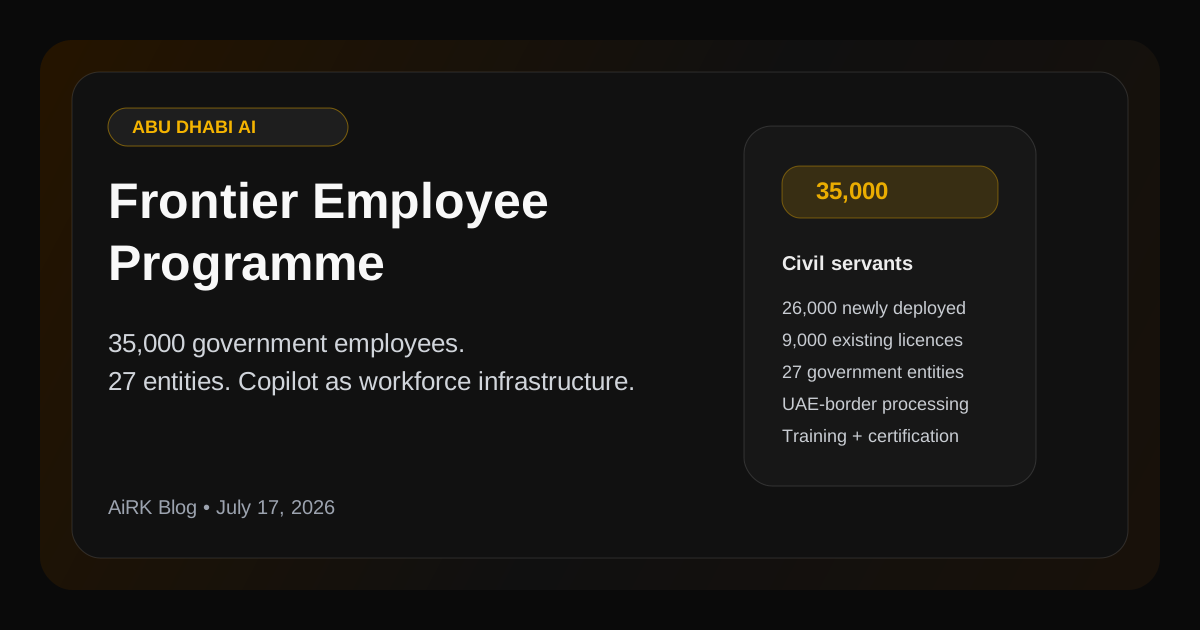
On 6 July 2026, the Abu Dhabi Media Office said Abu Dhabi Government had rolled out Microsoft 365 Copilot across the public sector through the Frontier Employee Programme, reaching 26,000 civil servants across 27 government entities and building on 9,000 existing licences to reach a total of 35,000.
That matters because it suggests Abu Dhabi is treating AI less like an optional tool choice and more like workforce infrastructure.
This is not only a software-procurement story.
It is a government operating-model story about what happens when AI is standardised, governed, and connected to daily work across a very large employee base.
The direct answer
This development matters because it moves Abu Dhabi's AI agenda from high-level ambition into role-level execution.
According to the official announcement, the rollout includes:
- Microsoft 365 Copilot as a standard AI productivity layer across government
Advanced Data Residency (ADR)so AI processing takes place within UAE borders- AI training and certification for employees
- an adoption and enablement framework covering rollout, change management, and safe use
- an
AI Factorytarget of hundreds of use cases and more than1,000 agentsacross the public sector
For leaders, government operators, enterprises, and AiRK learners, the practical implication is straightforward:
Abu Dhabi is raising the market standard from "people can access AI" to "institutions can run AI at workforce scale under governance"
What Abu Dhabi actually announced
The most important number is not only 35,000.
It is the combination of 35,000 employees, 27 entities, and a common platform for day-to-day work.
The official release says the programme aims to embed generative AI into daily operations and public-service delivery, with faster AI-assisted decision-making intended to translate into more responsive services for citizens, residents, and businesses.
That changes the meaning of the announcement.
This is not mainly about a few digital teams experimenting with assistants.
It is about a large public-sector system deciding that AI should sit inside mainstream work tools and be governed centrally enough to scale.
The same announcement also says the rollout builds on a wider strategic relationship between the Department of Government Enablement (DGE) and Microsoft across cloud, cybersecurity, AI-driven services, and workplace technologies.
That matters because workforce AI rarely scales well without a deeper institutional stack underneath it.
Why this is a stronger signal than a normal copilot rollout
Many organisations buy licences.
Far fewer redesign work around them.
This announcement is more useful because it includes the operating conditions that often separate durable AI adoption from shallow experimentation:
- sovereign processing expectations through
ADR - common enablement rules across entities
- user training and certification
- security, governance, and readiness assessments
- a pipeline for actual agents and use cases rather than only chat access
Microsoft's own product framing helps explain why this matters.
Its Microsoft 365 Copilot materials describe the system as AI built for work inside the applications people already use, and describe Copilot Cowork and agents as tools for handling complex tasks, staying grounded in work context, and automating workflows across daily apps.
So the more useful reading is not "Abu Dhabi bought more AI licences."
The more useful reading is:
Abu Dhabi is building a governed work environment where AI is expected to participate in how public employees actually operate
Why this matters for the UAE AI market
When a government deploys AI at this scale, the market signal spreads beyond government.
It affects:
- enterprise vendors serving the public sector
- training providers and workforce-development teams
- cybersecurity and governance operators
- implementation partners building workflow and agent layers
- professionals whose jobs now require AI judgment, not only AI awareness
The Abu Dhabi Media Office also says an AI Factory capability is being established across government with a target of hundreds of use cases and more than 1,000 agents, including functions such as document processing, constituent query handling, and policy analysis.
That is an important shift.
It suggests Abu Dhabi is moving from assistant access toward process architecture.
For the UAE ecosystem, that raises the value of people who can:
- identify which workflows are safe and useful to automate
- structure governance around AI-assisted decisions
- integrate agents into existing service and policy processes
- measure whether productivity gains actually improve public outcomes
- manage escalation when AI outputs are incomplete, weak, or risky
Why sovereignty and governance matter more here than in private pilots
The official release puts unusual emphasis on governance rather than novelty.
That is the right emphasis.
Public-sector AI at this scale changes the operational risk profile.
It requires stronger answers to questions such as:
- Where does data get processed?
- Which employees can access what information?
- How are outputs reviewed before they affect public services?
- Which use cases can be automated, and which still require human judgment?
- How does adoption stay consistent across many entities instead of fragmenting into tool chaos?
According to Microsoft, Copilot inherits Microsoft 365 permissions, sensitivity labels, and retention policies, and its enterprise positioning emphasises security, governed access, and built-in data privacy. That product context helps explain why Abu Dhabi would standardise around a governed productivity layer rather than only encourage ad hoc AI experimentation.
For the UAE market, this is a reminder that AI deployment quality increasingly depends on institutional controls, not only model capability.
What professionals should notice now
For AiRK's audience, this is a workforce signal first.
The winning skill is no longer just knowing how to prompt a model.
It is knowing how to work inside AI-shaped systems without losing judgment, security discipline, or service accountability.
That includes professionals who can:
- use AI tools inside real operational constraints
- understand the difference between productivity gains and governance failures
- translate policy into safe workflow design
- judge where agents can accelerate work and where they should stop
- work across technology, service delivery, and compliance functions
In other words, Abu Dhabi is increasing demand for AI-ready operators, not only AI enthusiasts.
What not to overclaim
This announcement does not prove that every employee will use AI well, or that every entity will convert licences into measurable productivity gains.
It also does not tell us:
- which use cases are delivering the strongest outcomes already
- how usage quality varies across entities
- how many workflows are agentic today versus planned
- what the long-term effect on service speed and quality will be
So the disciplined conclusion should stay narrower.
Abu Dhabi's Frontier Employee Programme is a significant UAE AI signal because it shows large-scale government adoption being tied to sovereignty, governance, training, and workflow deployment rather than only to tool access.
That is a stronger sign of ecosystem maturity than another generic AI partnership headline.
AiRK view for the UAE market
The next phase of UAE AI competition will not be decided only by who announces the biggest model, the biggest data centre, or the loudest strategy.
It will also be decided by who can make AI usable across thousands of workers without losing control, trust, or execution quality.
Abu Dhabi's Frontier Employee Programme matters because it shows one path toward that future: standardise the platform, govern the environment, train the workforce, and build agents around real operational demand. For leaders, that raises the bar for what serious AI readiness looks like. For professionals, it is a signal that practical AI literacy now includes workflow judgment, governance awareness, and the ability to operate well inside AI-enabled institutions.