
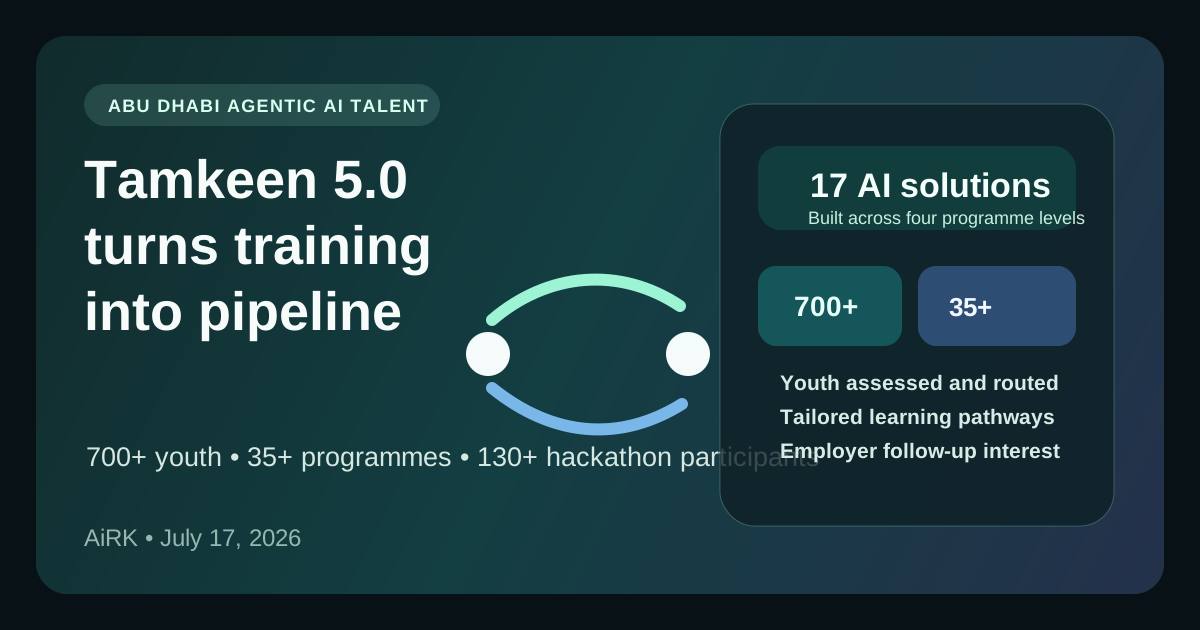
Tamkeen 5.0 shows Abu Dhabi is turning agentic AI youth training into a talent pipeline
Abu Dhabi's 7 July 2026 Tamkeen 5.0 update matters because it links AI skills assessment, tailored training, hackathon delivery, and employer follow-up into a more operational youth-to-jobs pipeline for the UAE's agentic AI economy.
The UAE AI conversation often jumps between frontier models, sovereign infrastructure, and government transformation.
Those matter.
But a harder long-term question sits underneath them:
how does the country move people from interest in AI into practical capability, then into work, implementation, and institutional demand?
That is why Tamkeen 5.0 is worth attention.
On 7 July 2026, the Abu Dhabi Media Office said the Abu Dhabi Youth Council concluded Tamkeen 5.0 with the Agentic AI for the UAE Hackathon, organised with EDGE Group. The official release said the programme's six-month pilot phase began at GITEX 2025, engaged more than 700 Emirati youth, offered more than 35 specialised programmes through 16 government entities, private-sector organisations, and academic institutions, and culminated in a hackathon involving more than 130 young Emiratis and 17 practical AI solutions.
That matters because it is not just another training announcement.
It is a more complete talent-pipeline signal.
The direct answer
Tamkeen 5.0 matters because it combines four layers that are often disconnected:
- skills assessment
- personalised learning pathways
- applied building through a hackathon
- follow-up interest from employers and public institutions
For the UAE AI market, that is more useful than a simple course catalogue or a generic youth-tech event.
It suggests Abu Dhabi is testing a system for moving Emirati youth from capability discovery to practical agentic AI output and, in some cases, toward employment and implementation opportunities.
What Abu Dhabi actually announced
The official release describes Tamkeen 5.0 as an intelligent digital enrollment ecosystem.
That wording matters because the programme did not only provide training seats. It assessed participants' AI knowledge levels, then connected them with learning pathways aligned to their starting point and development needs.
According to the Abu Dhabi Media Office:
- more than
700 Emirati youthwere engaged - the training library included more than
35 specialised programmes - delivery involved
16government, private-sector, and academic partners - the final hackathon brought together more than
130young Emiratis - participants developed
17 practical AI solutionsacross four programme levels
The same release also says key outcomes included professional development and employment opportunities for some participants through collaboration with EDGE Group and Mawaheb Talent Hub.
That is the strongest signal in the announcement.
This is not only about learning AI concepts.
It is about connecting AI training to labour-market pathways and real institutional interest.
Why this matters more than a normal youth-skills programme
Many training initiatives stop at attendance.
Tamkeen 5.0 appears to be trying to go further by testing whether participants can convert training into solutions that outside organisations actually want to examine.
The official release gives several concrete examples:
- the
Ministry of Interioris exploring potential adoption of the winning proposal at the Exploration Level inside its digital-services ecosystem durequested a follow-up meeting on the Professional Level winning project,RahhalInception, aG42company, began coordinating with the Advanced Level winning team to assess technical feasibility and future development opportunities- the
Government Acceleratorsteam showed interest in the Strategic Excellence Level winner,University of the Future
That combination is more important than the hackathon itself.
It suggests Abu Dhabi is trying to reduce a common AI-skills failure mode: people finish training, but there is no serious bridge into deployment, institutions, or hiring.
Why Mawaheb makes this more operational
The release says Mawaheb Talent Hub helped connect participants with specialised career and training opportunities in AI and advanced technologies.
That is not a minor detail.
According to the Department of Government Enablement, Mawaheb was launched to provide Emiratis with skills assessment, upskilling and reskilling, job matching, and professional-development support tied to labour-market demand.
So when Mawaheb appears inside Tamkeen 5.0, the programme looks less like a standalone youth initiative and more like part of a wider Abu Dhabi talent system.
That matters because the UAE AI market does not only need more awareness.
It needs repeatable mechanisms for:
- identifying who is ready for which training level
- placing people into more suitable development tracks
- converting projects into interviews, pilots, or roles
- linking government and enterprise demand to local talent formation
Why this matters for the UAE AI market
The practical implication is straightforward:
Abu Dhabi is testing agentic AI capability-building as workforce infrastructure, not just as enrichment activity
That has consequences for several groups:
- government teams that want local pipelines for future AI service delivery
- enterprises looking for junior talent that can already reason about applied AI workflows
- universities and training providers that need clearer progression pathways
- Emirati professionals deciding whether AI capability can convert into real opportunity
This also broadens the UAE AI talent story.
The country is not only investing in senior researchers, infrastructure hosts, or enterprise copilots. It is also trying to strengthen the earlier stage of the pipeline where interest becomes capability and capability becomes employability.
What professionals and AiRK learners should notice
For AiRK's audience, the useful lesson is not only that more AI courses exist.
It is that the market increasingly rewards people who can move from learning to demonstration.
The hackathon outcomes point to a more valuable profile:
- people who can frame real problems for agentic AI systems
- people who can turn training into prototypes or solution concepts
- people who can explain those ideas to employers, experts, and decision-makers
- people who can work across technology, public priorities, and operational constraints
The participant feedback in the official release also supports that reading. It says 95 per cent reported the training matched their knowledge levels, 80 per cent said they could apply what they learned practically, and 92 per cent said they had the confidence to present their ideas and solutions to leaders and experts.
Those figures do not prove labour-market success on their own.
But they do suggest the programme was designed around conversion from passive learning into applied participation.
What not to overclaim
This update does not prove that all 17 solutions will become deployed products, or that every participant will move into an AI role.
It also does not tell us:
- how many employment opportunities were ultimately created
- how many follow-up discussions will turn into pilots or hires
- whether the strongest outcomes came from a small subset of participants
- how the model will scale beyond the pilot phase
So the disciplined conclusion should stay narrower.
Tamkeen 5.0 is a meaningful Abu Dhabi AI signal because it connects assessment, tailored training, applied building, and employer attention in one programme design. That is a more mature ecosystem move than simply announcing more AI education.
AiRK view for the UAE market
The next serious AI advantage in the UAE will not come only from access to models or infrastructure.
It will also come from who can build dependable pathways from raw talent to usable capability.
Tamkeen 5.0 matters because it shows Abu Dhabi experimenting with that pipeline in a more structured way: assess talent, route people into appropriate training, require applied output, and connect the best work to institutions that can hire, test, or adopt it. For leaders, that raises the standard for what AI workforce development should look like. For professionals, it is a reminder that practical proof of capability is becoming more valuable than general AI enthusiasm.