
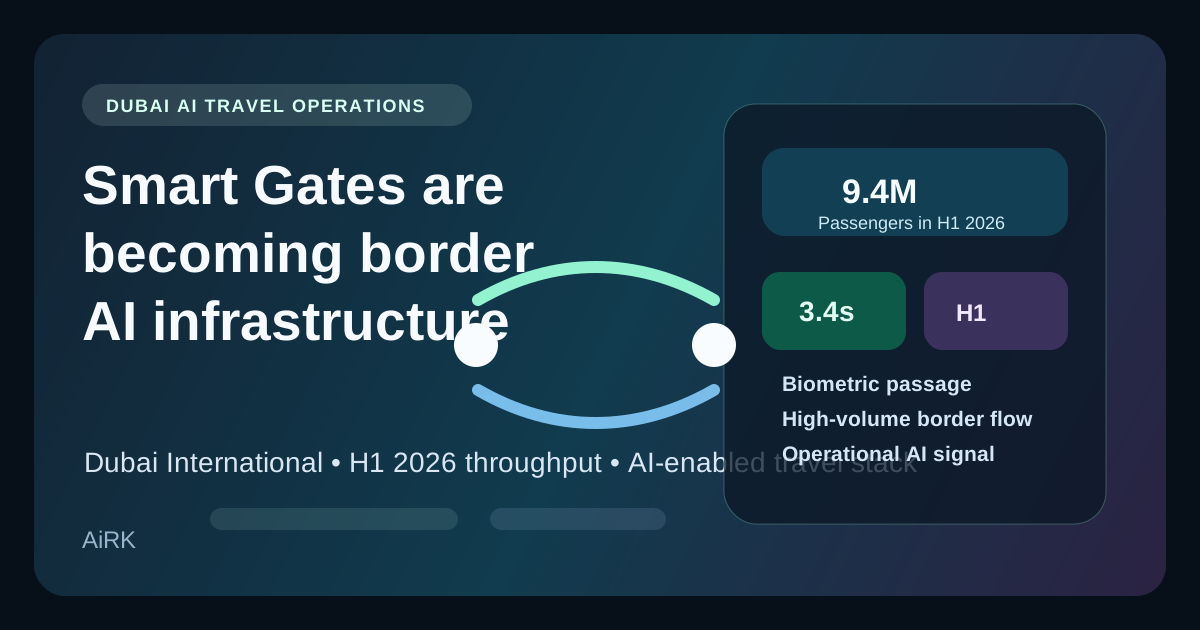
Dubai's Smart Gates numbers show AI travel infrastructure is becoming an operating system
Reported H1 2026 Smart Gates throughput at Dubai International matters because it suggests Dubai's AI-enabled travel stack is moving beyond showcase technology and into high-volume border operations with real throughput, workflow, and service-delivery implications.
Many UAE AI stories still focus on models, startups, or compute capacity.
Those matter.
But one of the more practical questions is simpler: where is AI already handling high-volume public operations under real time pressure?
That is why Dubai's latest Smart Gates numbers are worth attention.
On 13 July 2026, The Economic Times, citing GDRFA Dubai, reported that Dubai International's AI-driven Smart Gates processed 9.4 million passengers in the first half of 2026, with an average passage time of roughly 3.4 seconds. That report also said the system is part of a wider Smart Travel ecosystem that already serves eligible travellers through biometric and automated border flows.
Even allowing for the fact that the throughput figure is reported through secondary coverage rather than a full standalone GDRFA press release, the signal is still important.
For the UAE market, it suggests AI-enabled border automation is no longer a future-facing demo category. It is increasingly a live operating system for passenger movement.
The direct answer
This development matters because it shows Dubai pushing AI and automation deeper into one of the hardest public-service environments to run well:
- identity-linked passenger processing
- heavy daily transaction volume
- strict accuracy requirements
- visible service-quality expectations
- constant operational pressure during peaks
For leaders, government teams, airport operators, and AiRK learners, the takeaway is straightforward:
the next serious UAE AI opportunities are often found inside service operations that have to work at scale, not only inside office copilots
What the reported signal actually is
The key number is not just 9.4 million.
It is what that number implies when paired with 3.4-second average processing.
If a system can move that much passenger volume through automated gates in a major international airport, then the AI conversation changes.
This is no longer mainly about showcasing modern infrastructure to visitors.
It becomes a story about:
- queue reduction
- throughput engineering
- exception handling
- identity verification
- integration between biometrics, border controls, and traveller eligibility rules
Dubai Airports and airline guidance have already positioned Smart Gates as a real passenger-processing path for eligible travellers, not a side experiment. Earlier 2025 coverage around passport-free biometric travel also pointed to Dubai's ambition to turn automated passage into a more seamless operating layer inside the airport journey.
So the more useful reading is not "Dubai has smart gates."
The more useful reading is:
Dubai appears to be treating AI-enabled travel automation as infrastructure
Why this matters for the Dubai and UAE AI market
This matters because border and airport operations are a tougher AI category than many people assume.
These systems do not succeed because a model exists.
They succeed only when multiple layers work together:
- identity and eligibility data
- hardware reliability
- biometric matching quality
- exception routing to human officers
- passenger communications
- physical gate design
- peak-load resilience
That combination makes travel automation a better market signal than another generic AI pilot.
If Dubai can keep scaling this environment, it strengthens the case that UAE AI capability is becoming more credible in mission-critical public operations.
That matters well beyond airports.
The same operating logic carries into:
- ports and customs
- large government service centres
- healthcare intake and access control
- smart-city mobility infrastructure
- major venue and event operations
Why throughput is a better signal than another strategy announcement
The UAE has no shortage of AI strategy language.
What is more valuable now is evidence that people are actually moving through AI-shaped workflows in very large numbers.
Throughput is useful because it forces operational questions:
- Can the system hold up under volume?
- How are edge cases handled without collapsing the user experience?
- Which parts of the journey remain manual?
- How much staff effort is saved versus shifted into oversight?
- What governance is in place when identity, biometrics, and automation meet?
Those are harder questions than "Has an AI initiative been launched?"
For the UAE market, that is progress. It means the conversation is getting closer to execution quality.
What leaders should pay attention to now
Leaders should not reduce this to an airport-tech story.
The bigger lesson is that high-performing AI systems are increasingly being built around process choreography, not only model quality.
What matters is whether organisations can:
- decide which users qualify for automated pathways
- design fallback paths for failed or ambiguous matches
- integrate AI outputs into accountable human oversight
- keep service quality high during demand spikes
- treat trust, latency, and uptime as operating requirements
That is relevant for public-sector teams, regulated industries, and any enterprise trying to automate customer or citizen journeys without creating failure loops.
What this means for professionals and AiRK learners
For AiRK's audience, this is a practical workforce signal.
The market increasingly needs people who can work between policy, service design, operations, and AI systems.
That includes professionals who can:
- map where automation should and should not be used
- understand how biometric or identity-linked systems affect user journeys
- design escalation paths when automation fails
- judge whether a fast system is also a trustworthy system
- connect AI service layers to governance and frontline operations
In other words, the value is moving toward AI operators, not only AI users.
What not to overclaim
The reported 9.4 million passenger figure comes through secondary reporting that attributes it to GDRFA Dubai.
Without a full primary-source technical release, it would be too strong to claim:
- exactly how much of the flow is AI-mediated versus rules-based automation
- the error profile of the system
- how many exceptions still require manual intervention
- how evenly the experience applies across all traveller categories
So the disciplined conclusion is narrower.
Dubai's Smart Gates numbers are a meaningful market signal because they indicate that AI-enabled travel automation is being used at enough scale to matter operationally.
That alone makes it more important than many small pilot announcements.
AiRK view for the UAE market
The more interesting future for UAE AI is not only in chat interfaces.
It is in places where identity, movement, service quality, and public trust intersect under heavy load.
Dubai's reported Smart Gates performance suggests that this future is already taking shape inside travel operations. For leaders, that raises the bar for how AI should be evaluated: not by novelty, but by throughput, exception handling, trust, and disciplined execution. For professionals, it is a reminder that operational AI literacy is becoming a serious advantage across government, infrastructure, and service-delivery environments.