
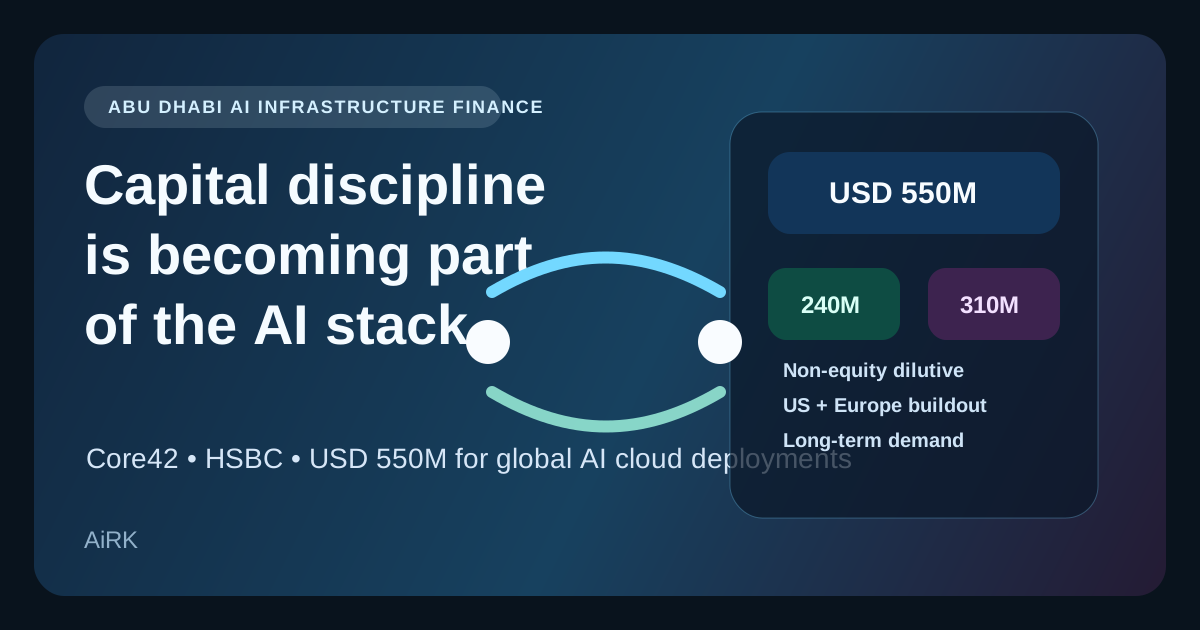
Core42's HSBC financing shows UAE AI infrastructure is becoming a capital-discipline market
Core42's 21 May 2026 USD 550 million HSBC financing matters because it shows Abu Dhabi AI infrastructure moving into a stricter phase where capital structure, contracted demand, and deployment discipline matter as much as model access.
The UAE AI story often gets told through launches, partnerships, and sovereign-compute headlines.
Those signals matter, but they do not always show whether the market is becoming financially durable.
That is why Core42's 21 May 2026 announcement is worth attention.
According to the company's official release, the Abu Dhabi-headquartered AI infrastructure operator arranged USD 550 million in structured trade finance facilities with HSBC to accelerate AI cloud and compute deployments across the United States and Europe. Core42 said the facilities were split between USD 240 million and USD 310 million, completed in February 2026 and May 2026 respectively.
For the UAE market, that matters because it points to a harder phase of AI maturity: capital discipline is becoming part of the operating stack.
The direct answer
This development matters because it shows UAE AI infrastructure is no longer only a technology or policy story.
It is increasingly a financing story too.
The practical implication is straightforward:
- scaling AI infrastructure now depends on structured capital, not only strategic ambition
- lenders are starting to treat AI capacity as long-duration industrial infrastructure
- UAE operators that want to compete globally need deployment discipline as well as technical capability
For leaders, enterprise teams, and AiRK learners, this is a useful signal that the market is moving beyond experimentation and into infrastructure economics.
What Core42 actually announced
Core42 said it arranged two non-equity-dilutive structured trade finance facilities with HSBC totalling USD 550 million.
The company described the financing as purpose-built for the capital intensity and deployment cycles of AI cloud infrastructure. It said the facilities are intended to support time-to-market for large-scale capacity buildouts tied to long-term contracted demand and enterprise-grade workloads.
That language matters.
This is not a generic growth-funding story. It is a sign that AI infrastructure is being treated more like a serious industrial asset class, where financing structure, demand visibility, and deployment timing all affect competitiveness.
Why this is a stronger UAE signal than another infrastructure headline
The UAE has produced many AI infrastructure announcements already.
What makes this one more useful is the financing mechanism.
When a UAE-headquartered operator can secure large structured facilities from a global bank for AI cloud deployments, the signal is not only "more compute is coming."
The stronger signal is this:
parts of the UAE AI ecosystem are becoming credible enough to attract specialised capital against future infrastructure demand
That changes the conversation.
It suggests the market is starting to reward operators that can show:
- capital allocation discipline
- large-scale deployment capability
- cross-border execution
- enough customer demand visibility to support financing
Those are harder tests than announcing another product integration or model partnership.
Why contracted demand matters for UAE enterprises
Core42 said the facilities support buildouts tied to long-term contracted demand.
That phrase should stand out for UAE leaders.
It suggests the next phase of AI competition will not be won only by whoever experiments first. It will be shaped by who can lock in real workloads, build capacity against them, and operate that infrastructure with governance and financial discipline.
For enterprise and government buyers, that matters because supplier quality starts to look different in this environment.
The more important questions become:
- Can this provider support sustained production workloads, not just pilots?
- Does the provider have a credible capital base for ongoing expansion?
- How much of the AI stack is backed by real operational planning rather than branding?
- What does this mean for pricing power, delivery reliability, and sovereign deployment options over time?
These are not abstract infrastructure questions. They affect procurement, vendor selection, and execution risk.
Why this matters for the UAE talent market
For AiRK's audience, the workforce implication is practical.
As AI infrastructure matures, the market needs more people who understand the middle layer between strategy and engineering.
That includes professionals who can:
- translate business demand into workload and deployment requirements
- evaluate AI vendors beyond demo quality
- understand how governance, data residency, and performance needs shape infrastructure choices
- connect AI initiatives to budgets, timelines, and accountable delivery
In other words, the market keeps raising the value of AI operators, not only AI users.
Why the Europe and US angle still matters locally
Core42 framed the financing around deployments across the United States and Europe.
That does not mean the full benefit flows directly into the local UAE enterprise market, and it would be too strong to claim otherwise.
But it does matter for the UAE ecosystem for a different reason.
It shows an Abu Dhabi-headquartered operator trying to scale as a global infrastructure business, not only as a domestic technology brand. That raises the credibility of the UAE as a base for AI infrastructure operators that can compete internationally while still serving sovereign, enterprise, and government use cases.
For the local market, that strengthens the case that Abu Dhabi is participating in the business model layer of AI, not only consuming external platforms downstream.
What leaders should do with this signal
The right response is not to chase financing headlines for their own sake.
A better response is to use them as a readiness test.
Leaders should ask:
- Which of our AI ambitions depend on external infrastructure providers?
- Are we evaluating AI partners for financial resilience as well as technical fit?
- Which workloads actually justify sovereign, private, or tightly governed environments?
- Do we have enough internal capability to manage AI delivery after procurement?
Those questions matter more now because infrastructure is becoming less of a background utility and more of a strategic dependency.
What not to overclaim
Core42's release is still a company announcement.
It does not prove that every financed AI infrastructure buildout will succeed, or that all UAE enterprises will benefit equally from this type of capital access.
It also does not mean that financing alone solves the UAE's AI readiness gap. Workforce capability, governance, and use-case quality still matter.
So the disciplined conclusion is narrower.
This financing is a meaningful UAE market signal that AI infrastructure is entering a stricter phase where capital structure, contracted demand, and deployment discipline increasingly shape who can scale.
AiRK view for the UAE market
Core42's HSBC financing is useful because it shifts attention from hype to operating reality.
The next phase of UAE AI will not be defined only by which organizations have access to models. It will be defined by which ones can fund, govern, deploy, and sustain AI systems at production scale.
For professionals, that raises the value of infrastructure literacy, delivery judgment, and role-based AI capability. For leaders, it is a reminder that serious AI adoption increasingly depends on financial durability as much as technical ambition.