
Presight's Q1 numbers show Abu Dhabi AI is turning into an operating business
Presight's 12 May 2026 Q1 results matter because they show UAE AI demand appearing in revenue, EBITDA, backlog, and recurring government-and-enterprise delivery rather than only in partnership announcements.
The UAE AI conversation often focuses on launches, partnerships, and platform claims.
Those signals matter, but they do not always show whether AI is becoming a real operating market.
That is why Presight's 12 May 2026 first-quarter results are useful.
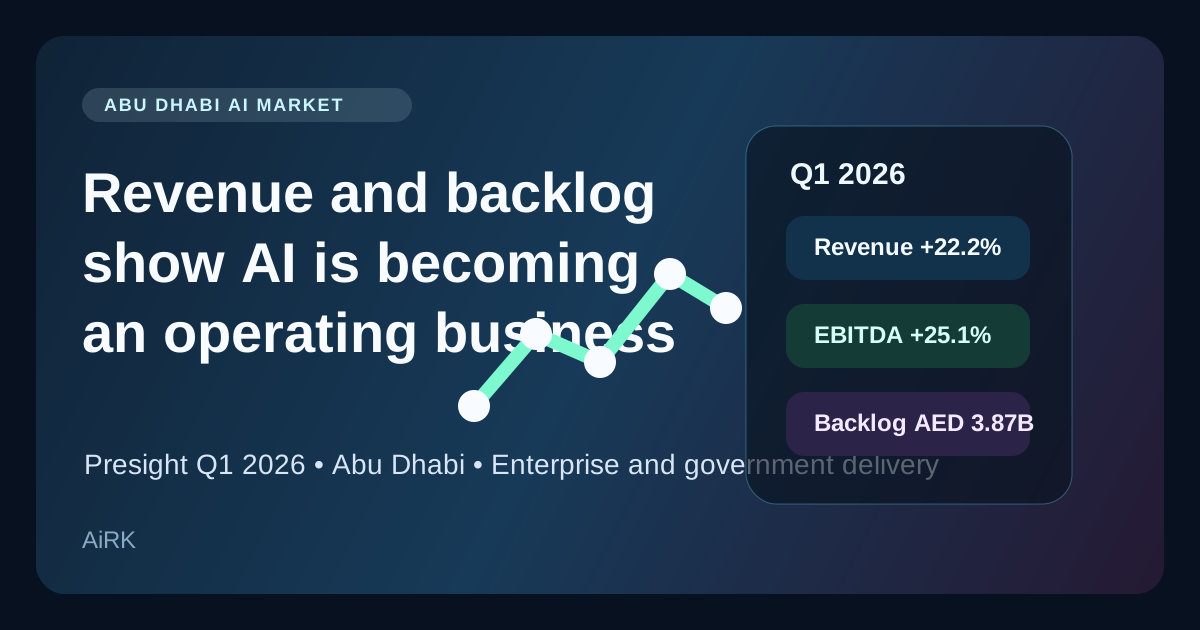
In its official release, the Abu Dhabi-based AI and analytics company reported AED 563.1 million in revenue for Q1 2026, up 22.2% year on year. It also reported double-digit growth in EBITDA and profit after tax, alongside a backlog of AED 3.87 billion.
For the UAE market, that matters because it is a harder signal than another memorandum or pilot. It suggests that AI work in Abu Dhabi is being converted into booked demand, multi-quarter delivery, and measurable execution.
The direct answer
This development matters because it shows that parts of the UAE AI ecosystem are moving beyond awareness and procurement theatre.
The practical implication is simple:
- AI demand is showing up in revenue, not only headlines
- delivery scale is increasingly tied to government and enterprise operating environments
- the market is starting to reward organisations that can execute AI programmes over time, not only launch them
For leaders, professionals, and AiRK learners, that is a more actionable signal than generic hype. It points to a UAE market where implementation discipline is becoming commercially visible.
What Presight actually reported
According to Presight's Q1 2026 earnings release, the company delivered:
AED 563.1 millionin revenue, up22.2%year on yearAED 163.5 millionin EBITDA, up25.1%AED 144.8 millionin profit after tax, up18.9%AED 3.87 billionin backlog
Presight also said its UAE business remained a major contributor while international work expanded, including activity in Kazakhstan and deals linked to global financial-services and public-sector use cases.
That mix matters.
It shows Abu Dhabi is not only producing AI announcements. It is producing companies that are converting applied AI, analytics, and smart-city style work into repeatable contracts and delivery commitments.
Why this is more useful than a normal partnership story
Partnership announcements are easy to overread.
Financial results are different because they force a narrower question: is the market actually paying for this?
Presight's Q1 update does not prove that every UAE AI initiative is healthy or that every enterprise deployment is succeeding.
But it does show something more grounded:
there is enough real demand in the market for a listed UAE AI company to report growth in revenue, profitability, and backlog at the same time
That is a stronger ecosystem signal than another concept launch.
Why this matters for UAE leaders and enterprise teams
For many organisations, the hard part of AI is no longer generating interest.
The hard part is delivering:
- governed use cases
- multi-team execution
- procurement-ready operating models
- measurable outcomes over several quarters
Presight's numbers suggest that buyers in the UAE and wider region are willing to fund AI when it is attached to infrastructure, public operations, analytics, and large-scale enterprise workflows.
That should change how leaders think about readiness.
The question is no longer only "should we experiment with AI?"
It is increasingly:
- Which workflows are important enough to justify sustained AI delivery?
- Do we have the operators, analysts, and managers who can run AI programmes after the initial launch?
- Are we treating AI as a budget line with accountability, or as a short-lived innovation exercise?
What professionals should notice now
For AiRK's audience, this is a market signal about career value.
As AI spending becomes more operational, demand rises for people who can work between strategy and delivery.
That includes professionals who can:
- map a real workflow before an AI tool is introduced
- translate business requirements into data, governance, and deployment requirements
- manage vendor delivery against operational outcomes
- evaluate whether an AI initiative is producing usable value or just dashboard activity
- build internal literacy so teams can adopt AI safely and consistently
In other words, the UAE market is likely to keep rewarding AI operators, not only AI enthusiasts.
What not to overclaim
Presight's public release is still a company announcement.
It does not, by itself, validate every customer outcome or prove that the whole UAE AI market is growing evenly across sectors.
Backlog is also not the same thing as recognized revenue, and one company's performance should not be treated as the entire market.
So the disciplined conclusion is narrower.
Presight's Q1 numbers are a useful Abu Dhabi signal that AI in the UAE is becoming more commercial, more operational, and more tied to delivery capacity over time.
AiRK view for the UAE market
This is the kind of signal leaders should take seriously.
When an Abu Dhabi AI company reports growth in revenue, EBITDA, profit, and backlog together, the market conversation changes.
AI stops looking like a collection of pilots and starts looking more like an operating business category.
For professionals, that raises the value of execution skills, governance judgment, and role-based AI capability. For leaders, it raises the bar on whether the organisation can move from experimentation to accountable delivery.