
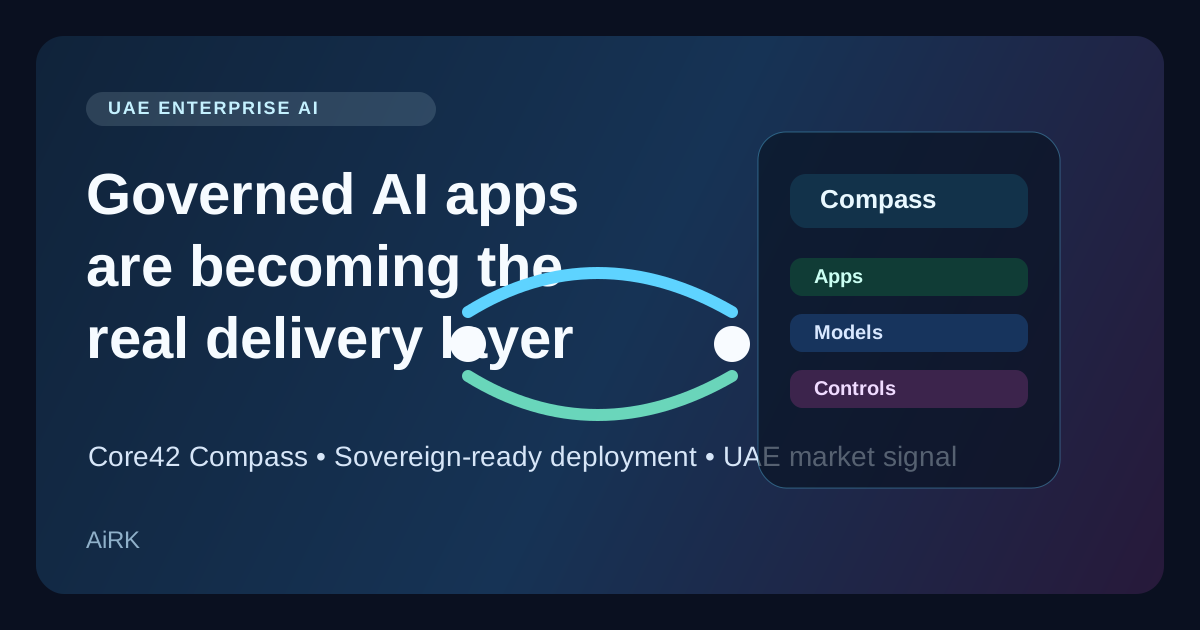
Core42's Compass expansion shows where UAE enterprise AI gets operational
Core42's 4 June 2026 integration of Open Innovation AI Apps into Compass matters because it shows the UAE market moving beyond model access and toward governed delivery of enterprise AI applications inside sovereign-ready environments.
The UAE AI conversation often jumps between two extremes.
At one end, there are big infrastructure headlines about compute, cloud, and sovereign AI.
At the other, there are end-user stories about copilots, prompts, and productivity gains.
What often gets missed is the middle layer that determines whether AI becomes durable inside a real organisation: the delivery layer for governed applications.
That is why Core42's 4 June 2026 announcement matters.
According to the company, Open Innovation AI Apps are now available through Core42 Compass, its unified API platform for enterprise AI. Core42 said the integration gives organisations access to AI applications inside secure, scalable, and sovereign-ready environments, with options for SaaS delivery and on-premises deployments where required.
For the UAE market, that is a practical signal that enterprise AI is maturing from infrastructure access into operational application delivery.
The direct answer
This development matters because it shows a more usable UAE adoption path for organisations that want AI in production but do not want to build the whole stack themselves.
The practical implication is straightforward:
- infrastructure alone is not enough
- model access alone is not enough
- enterprises increasingly need governed application delivery that can fit existing operating environments
For leaders, government teams, and AiRK learners, the signal is that the UAE market is rewarding teams that can connect AI tools to control, deployment, and business workflows, not only experimentation.
What Core42 actually announced
Core42 said Open Innovation AI Apps are now integrated into the Compass API Platform, allowing customers to access enterprise AI applications through a broader unified platform.
The announcement makes three points that matter.
First, Compass is positioned as a single access layer for generative AI models, tools, and applications.
Second, Core42 frames the environment around sovereign deployment, data residency, and jurisdictional control.
Third, the integration is not limited to one deployment pattern. Core42 said customers can use the apps through its managed environment, while organisations with stricter requirements can access Open Innovation AI's broader stack for on-premises, cloud, and hybrid setups.
That combination matters more than the partnership headline itself.
It suggests the UAE market is building a more practical middle ground between:
- fully outsourced AI tooling with limited control
- fully custom AI stacks that many organisations do not have the time or skills to build
Why this is different from a normal infrastructure story
The UAE has already produced plenty of infrastructure signals.
What is more useful here is the move up the stack.
This is not only about where models run. It is about how organisations get usable AI applications into governed operating environments without treating every deployment as a bespoke engineering project.
That matters because many organisations are now past the awareness stage.
Their real questions are more operational:
- How do we move from pilots to repeatable internal deployment?
- Which AI applications can run inside approved environments?
- How much control do we retain over data, workflows, and deployment architecture?
- Can we support both managed and on-premises use cases without redesigning everything?
Core42's announcement does not solve all of those problems on its own.
But it does show the UAE ecosystem responding to them directly.
Why this matters for UAE enterprises and government-linked teams
Many UAE organisations do not need another generic AI demo.
They need a way to deliver AI inside environments that already have:
- policy constraints
- data-handling rules
- approval workflows
- operational accountability
- legacy systems that still matter
That is why governed app delivery is important.
It reduces the gap between "we have access to models" and "we can actually run something useful with oversight."
For government teams and regulated enterprises, this matters even more. AI adoption gets harder when data sensitivity, auditability, and deployment control become non-negotiable. In those settings, the value is often not the model alone. It is the package of platform, control, application logic, and deployment choice.
What professionals should notice now
For AiRK's audience, this is a useful market-readiness signal.
The UAE is creating demand for people who can work in the space between business need and technical deployment.
That includes professionals who can:
- map a workflow before an AI app is introduced
- decide which use cases can stay in managed environments and which need tighter control
- translate business requirements into deployment constraints
- define human review, escalation, and accountability rules
- judge whether an AI app is actually production-ready for the organisation using it
This is not only an engineering issue.
Operations leaders, digital teams, policy teams, security functions, transformation managers, and procurement leads all need better judgment in this layer.
What leaders should do with this signal
A sensible response is not to chase every sovereign-AI product claim.
A better response is to tighten the organisation's deployment logic.
Leaders should ask:
- Which workflows are good candidates for governed AI apps now?
- Which use cases require on-premises or hybrid deployment instead of standard SaaS access?
- Where would data residency or jurisdictional control materially change vendor selection?
- Do we have the internal operators who can own AI deployment after the pilot phase?
Those are more valuable questions than "which model is best?" for many UAE organisations right now.
What not to overclaim
The public announcement does not provide outcome metrics, customer case studies, or proof that every enterprise AI app on the platform will deliver value immediately.
It also does not mean sovereign-ready delivery is necessary for every organisation or every use case.
So the disciplined conclusion is narrower.
This announcement shows that the UAE ecosystem is getting more serious about the delivery architecture of enterprise AI, especially for organisations that need more control than off-the-shelf AI access usually provides.
AiRK view for the UAE market
Core42's Compass expansion is a useful UAE market signal because it sits in the middle layer that many organisations underestimate.
The next phase of AI adoption in the UAE will not be won only by the teams with the best demos or the biggest infrastructure claims. It will be won by the teams that can turn AI into governed, repeatable delivery inside real operating environments.
For professionals, that raises the value of workflow design, deployment judgment, and AI governance literacy. For leaders, it means AI readiness increasingly depends on whether the organisation can connect models, applications, controls, and ownership into one workable system.