
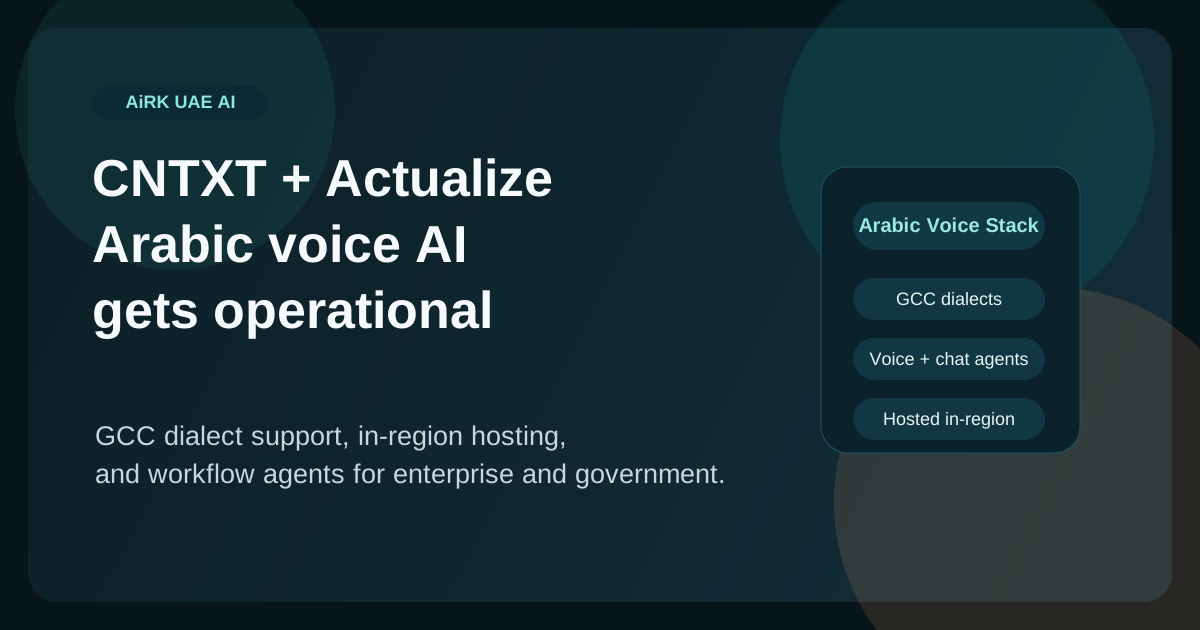
CNTXT's Actualize deal shows where GCC Arabic voice AI gets operational
Actualize's public acquisition notice and CNTXT's Arabic-first AI stack matter because they point to a more practical GCC market: voice agents that are localized for Gulf dialects, hosted in-region, and designed to complete enterprise and government workflows instead of only answering questions.
The UAE AI market is often discussed through models, chips, and mega-projects.
But another market is becoming easier to see: Arabic voice AI built for real enterprise and government work.
That is why the CNTXT and Actualize combination is worth watching.
As of 18 June 2026, Actualize's homepage says its AGNTIX and FASEEH products "have been acquired by CNTXT". The same site positions those products around native Arabic voice models, GCC dialect support, in-region hosting, on-premise deployment, and workflow automation. Separately, an Economic Times report originally published on 16 June 2026 says CNTXT AI acquired Actualize to strengthen Arabic voice AI for enterprise and government use across the GCC.
This is not only another startup story.
It is a practical signal that GCC AI demand is moving beyond generic chat and toward voice systems that can take action inside real operations.
The direct answer
This matters because the UAE and wider GCC increasingly need AI systems that fit how Arabic is actually spoken, how regulated teams operate, and how service workflows are delivered.
The useful market signal is not simply that one company bought another.
The more important signal is that localized Arabic voice capability, workflow automation, and sovereign deployment are being bundled together into a more deployable enterprise stack.
For professionals, leaders, and government teams, that matters because many of the next high-frequency AI use cases in the region are not screen-first.
They are interaction-heavy, service-heavy, and multilingual.
What the source material actually shows
Based on the public pages now live:
Actualizesays its AGNTIX and FASEEH products were acquired by CNTXTActualizedescribes itself as built in the UAE with native Arabic dialect intelligence, hosted-in-GCC deployment, and on-prem supportFASEEHis positioned as a low-latency Arabic speech system for Gulf and wider regional dialectsAGNTIXis positioned as a voice, chat, and workflow automation platform for enterprise use casesCNTXTdescribes itself as an Arabic-first AI and data company focused on production-ready, in-region, compliance-aware deployments- the reported transaction coverage says the combined stack is intended for enterprise and government environments
That is enough to support a cautious conclusion:
the GCC Arabic AI market is maturing from standalone models into workflow-linked voice systems.
Why this is a bigger GCC signal than it first appears
Arabic AI is often treated too narrowly, as if the challenge is only translation or basic chatbot response quality.
In practice, the harder regional problem is operational:
- understanding Gulf dialect variation
- handling Arabic speech with low latency
- connecting voice interaction to real back-office actions
- deploying systems in-region or on-premise for regulated environments
- making the experience work across customer service, government, healthcare, finance, and internal enterprise operations
That is what makes this development more important than a normal product launch.
It suggests providers increasingly believe the winning offer in the GCC is not only a model.
It is a deployable operating layer for Arabic voice workflows.
Where the practical impact could show up first
The near-term impact is most likely in environments where voice interaction is frequent, structured, and operationally expensive when handled manually.
That could include:
- customer-service call flows
- appointment booking and follow-up
- internal helpdesks and shared services
- collections, reminders, and transaction support
- healthcare front-desk and patient communications
- public-sector service centers
- bilingual workflows where Arabic quality cannot be treated as optional
For UAE and GCC organisations, this is a real constraint.
Many AI pilots perform reasonably well in English text but fail once teams need regional Arabic speech, handoff logic, and secure deployment.
If this combination improves that layer, it could reduce one of the more stubborn barriers between demo and production.
What leaders should pay attention to now
The relevant leadership question is not whether voice AI sounds impressive in a demo.
The relevant question is whether it can operate safely inside day-to-day service environments.
Leaders should pay attention to:
- whether Arabic support covers actual dialect and domain variation, not only Modern Standard Arabic
- whether the system can complete tasks rather than only produce responses
- whether hosting, governance, and auditability fit regulated or public-sector use
- how voice AI will be evaluated for accuracy, escalation, and failure handling
- whether teams have the process discipline to redesign workflows around automation rather than bolt AI onto weak operations
These are implementation questions first.
That is why this story matters for the market.
What this means for AiRK's audience
For AiRK's audience, this is another sign that GCC AI readiness now requires more than prompt literacy.
It increasingly requires people who can:
- assess Arabic AI quality in real business contexts
- compare hosted, sovereign, and on-prem deployment options
- map service workflows into automation steps
- manage escalation and governance for AI agents
- understand where voice interfaces create better adoption than text-only tools
That matters for enterprise managers, digital teams, government operators, founders, and training audiences across the UAE.
The region will need more professionals who can translate AI capability into service design, workflow redesign, and operating controls.
The broader UAE and GCC market reading
Read carefully, this is a useful regional maturity signal.
The UAE AI market is not only building frontier infrastructure and research visibility.
It is also building the middle layer that many organisations will actually buy:
- Arabic-native models
- workflow-linked AI agents
- in-region deployment
- regulated-sector readiness
- action-oriented service automation
That is where a lot of commercial value gets created.
If this category keeps improving, then GCC adoption could shift faster in sectors where voice remains the natural interface and Arabic quality directly affects trust.
That would make Arabic voice AI less of a showcase feature and more of a real operating capability.