
Abu Dhabi's new planning stack shows where AI gets operational in the built environment
Abu Dhabi's 12 June 2026 rollout of Nabd and a real-time 3D planning system matters because it turns AI in the UAE from a dashboard story into a planning-and-approvals execution story for infrastructure, government, and enterprise teams.
The UAE AI market is often framed around models, compute, and flagship partnerships.
That is only part of the story.
Another important question is whether AI and data systems are being embedded inside the way cities are planned, reviewed, and improved.
That is why Abu Dhabi's latest planning-technology announcement matters.
On 12 June 2026, the Department of Municipalities and Transport (DMT) said it had launched two advanced digital planning technologies: Nabd, a live three-dimensional model of the emirate, and Our Holographic Future, a real-time 3D hologram system for testing development scenarios before construction begins.
This is not a consumer AI headline.
It is a signal that Abu Dhabi is pushing AI-adjacent planning infrastructure deeper into real operating environments where government teams, developers, infrastructure operators, and service leaders have to make decisions with speed and accountability.
The direct answer
This matters because Abu Dhabi is moving AI-era planning from concept work into decision infrastructure.
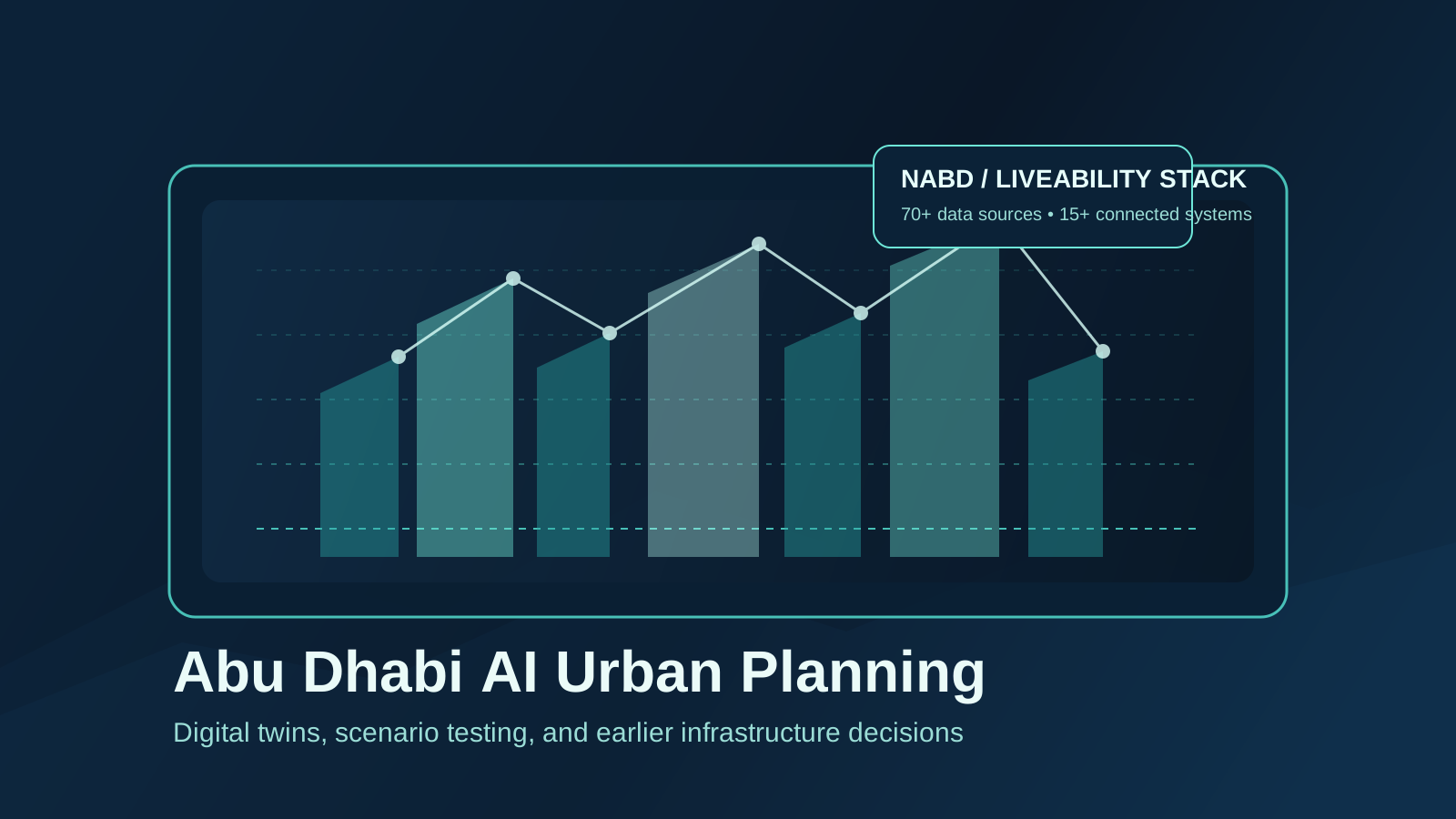
According to the official announcement, Nabd is designed to combine real-time city modelling, operational data from more than 70 data sources, links to more than 15 connected systems, planning analytics, and neighbourhood liveability indicators in one environment.
That changes the practical question for teams in the UAE.
The question is no longer only whether an organisation has access to AI tools.
The question is whether it can make better decisions when data, spatial context, service performance, and future scenarios are brought together early enough to change outcomes.
Why this is a more important UAE signal than it first appears
A large share of AI discussion still sits at the interface layer.
People talk about copilots, chat tools, and automation assistants, but much less about the systems underneath planning, approvals, infrastructure coordination, and public-service delivery.
DMT's announcement points to a different layer of the market:
- integrated spatial data
- live operational visibility
- scenario testing before physical delivery
- neighbourhood-level liveability measurement
- faster coordination across public-sector and delivery teams
That matters because the built environment is one of the hardest places to improve with technology.
If Abu Dhabi is serious about using live digital models and forward-looking visualisation in planning, then AI in the UAE is becoming less about novelty and more about institutional execution.
What DMT actually announced
The official release provides enough detail to make the practical direction clear, even if it does not claim full deployment is complete today.
The most relevant points are these:
- Nabd creates a live digital model of Abu Dhabi that includes buildings, roads, utilities, underground infrastructure, and other urban assets
- the platform brings together data from across DMT systems, sensors, and infrastructure
- DMT says the platform is intended to improve coordination, visibility, and earlier identification of issues and opportunities
- a liveability dashboard is meant to show neighbourhood-level conditions such as service accessibility, infrastructure availability, and community facilities
- phase one of Nabd is expected to go live in
early 2027 - the real-time hologram system is designed to help planners and decision-makers test future development scenarios before construction
That is a serious operational framing.
It suggests the emirate wants planning teams to compare options earlier, see second-order effects faster, and reduce the lag between urban analysis and delivery decisions.
Where the practical impact could show up first
For professionals and leaders in the UAE, the most immediate impact is likely to appear in workflows that sit between planning, infrastructure, transport, public services, and development approvals.
That could include:
- earlier review of land-use and infrastructure trade-offs
- quicker coordination between planning, transport, utilities, and service teams
- stronger evidence for where neighbourhood investment is needed
- more realistic testing of pedestrian experience, shade, sightlines, and public-space design before delivery
- pressure on developers and operators to work with better structured spatial and operational data
This is especially relevant for teams that manage complex assets or multi-stakeholder delivery environments.
When a city-scale planning stack starts to pull together data, systems, and scenario modelling, weak handoffs become more visible.
What leaders should pay attention to now
The interesting part is not just that Abu Dhabi has a new platform name.
The interesting part is the operating discipline implied by the announcement.
Leaders should pay attention to:
- whether their own planning and delivery workflows still rely on fragmented data and static documents
- how quickly teams can move from a proposed design to a tested scenario with measurable trade-offs
- whether staff are trained to interpret AI-supported or data-rich planning outputs rather than treat them as automatic truth
- how liveability, service accessibility, and infrastructure quality will be measured in a way that changes decisions
- whether approval, operations, and delivery teams are structured to act on earlier signals instead of discovering problems late
These are not only technology questions.
They are management and capability questions.
What this means for AiRK's audience
For AiRK's audience, this is a reminder that the UAE AI market is widening into domain-heavy environments where context matters more than generic prompting.
The people who will benefit most are not only AI engineers.
They are also:
- government and quasi-government managers who need to translate AI into better service and planning decisions
- infrastructure and real-estate leaders who need teams that can work with scenario tools, dashboards, and data-led planning
- analysts and operators who can validate model-assisted outputs instead of blindly trusting them
- training teams that can teach role-based AI adoption for planning, operations, and public-service environments
In other words, the opportunity is shifting from "use AI" to "operate better with AI-shaped systems."
That is a more durable market signal.
The broader UAE market reading
Read together with the UAE's wider push into digital government, sovereign AI infrastructure, and role-based workforce development, DMT's announcement suggests another maturation step in the ecosystem.
AI is moving into the machinery of how decisions are made, not just into the tools people open on a laptop.
That has real implications for Abu Dhabi and the wider UAE:
- implementation quality will matter more than headline ambition
- data integration and governance will become harder to separate from AI readiness
- professionals who understand operations, planning, and accountability will become more valuable
That is why this announcement is worth watching.
It shows where AI becomes part of the city itself: inside planning logic, approval speed, service coordination, and the everyday quality of the built environment.