
Abu Dhabi's latest industrial job fair shows AI hiring is no longer theoretical
The Industrialists Career Exhibition 2026 matters because it turns UAE AI demand into a labour-market signal: AI roles are now showing up alongside engineering, manufacturing, and digital jobs in a live hiring environment, not only in strategy decks.
The UAE AI story is often told through model launches, data centres, government strategies, and university research.
Those matter.
But labour-market signals matter too.
They tell you whether AI demand is staying inside strategy language or moving into real hiring behaviour.
That is why the Industrialists Career Exhibition 2026 in Abu Dhabi deserves attention.
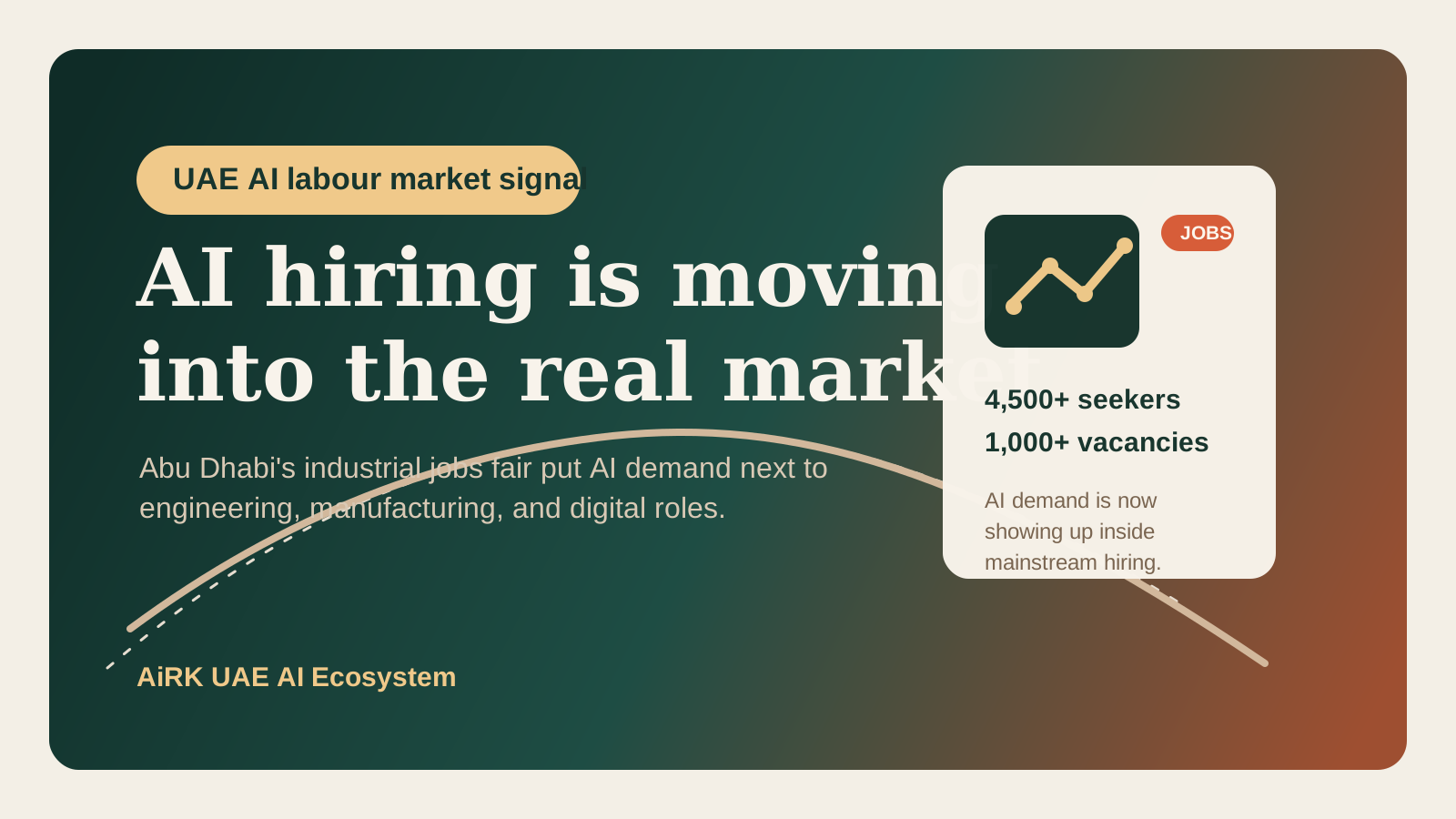
Secondary reporting published on 10 June 2026 said the event drew more than 4,500 Emirati job seekers and featured more than 1,000 vacancies across engineering, manufacturing, artificial intelligence, digital technology, and other future-focused categories.
This is not a full labour-market dataset. It is not a complete map of every AI role in the UAE. And the event-level figures are more visible through secondary coverage than through a detailed official recap currently surfaced in search.
Even so, it is a useful market signal.
It suggests that AI hiring in the UAE is becoming more visible inside the same workforce conversation as industrial capability, engineering, and digital transformation.
The direct answer
This matters because it shows AI work in the UAE becoming part of a practical employment market, not just an innovation narrative.
For professionals, leaders, enterprises, government teams, and AiRK's training audience, the implications are straightforward:
- AI demand is appearing closer to mainstream hiring activity, not only in specialist labs or boardroom plans
- industrial and digital transformation agendas are pulling AI into the same talent pipeline
- employers are likely to value applied execution skills over generic AI enthusiasm
- workforce readiness is becoming a competitive issue for employers, operators, and training providers alike
That is the important reading.
The strongest signal is not simply that a job fair mentioned AI.
The stronger signal is that AI was presented alongside sectors where execution matters, where hiring needs are immediate, and where organisations care about people who can do useful work inside real operating environments.
What the latest reporting says
According to the 10 June 2026 Times of India report, the exhibition in Abu Dhabi:
- attracted more than
4,500Emirati job seekers - offered more than
1,000vacancies - included demand across AI, engineering, manufacturing, and digital technology
- formed part of a broader Emiratisation push tied to private-sector capability-building
Those numbers should be handled carefully.
At the time of writing on 16 June 2026, they are useful as a timely directional signal, but they should not be treated as a full official labour-market release or a precise measure of UAE-wide AI hiring by themselves.
That is why the right conclusion here is disciplined.
The event does not prove that every company is hiring for AI at scale. It does not tell us the exact number of AI-specific roles, salary bands, seniority ranges, or placement outcomes. But it does show that AI talent demand is visible enough to appear in a high-attention employment setting tied to the UAE's industrial and future-skills agenda.
Why this matters in the UAE now
The UAE has spent the last year making AI look more operational.
The country has expanded the conversation through:
- government AI delivery and service redesign
- sovereign infrastructure and compute strategy
- university-led capability-building
- sector-specific AI in health, finance, logistics, manufacturing, and public services
- executive and workforce education
What has been harder to read is how quickly that activity is translating into jobs that normal professionals can actually compete for.
That is where this exhibition matters.
When AI demand shows up in a live jobs environment alongside industrial and engineering roles, it suggests the market is moving beyond awareness campaigns.
It suggests employers want people they can place into transformation work, operations, digital programmes, technical implementation, and adjacent business functions.
That is a different stage of market maturity.
The industrial angle is the real story
There is a temptation to read every AI jobs headline as a software story.
That is too narrow.
This event matters more because it links AI demand to an industrial workforce setting.
That has practical consequences.
In the UAE, many valuable AI use cases are not only about chat tools or consumer apps. They sit inside:
- manufacturing operations
- asset-heavy businesses
- engineering support
- inspection and monitoring
- planning and scheduling
- procurement and supply-chain workflows
- service optimisation
- enterprise reporting and decision support
When AI hiring sits near these functions, employers are often looking for people who can bridge domain work and AI-enabled execution.
That does not always mean they need frontier researchers.
Often they need:
- analysts who can work with AI tools inside business processes
- operators who can improve workflows with automation
- technical staff who understand data quality and implementation constraints
- managers who can scope AI use cases properly
- trainers who can raise role-based AI competence across teams
That is good news for the UAE workforce.
It means the labour market may reward practical AI capability even when someone is not an elite machine-learning specialist.
What leaders should pay attention to
Leaders should not ask only, "Are there AI jobs?"
They should ask more useful questions:
- which roles in our organisation now need AI fluency even if "AI" is not in the title
- where are we competing for the same people as industrial, digital, and engineering employers
- whether our hiring plans overestimate scarce senior specialists and underestimate trainable internal talent
- how quickly line managers can identify useful AI tasks inside everyday work
- whether our current learning programmes teach deployment judgment, not just tool awareness
These questions matter because many organisations still treat AI hiring as a search for a small number of unicorn profiles.
That is rarely the most practical answer.
In many UAE teams, the faster path is to combine selective hiring with structured upskilling for existing staff.
What this means for professionals
For professionals in the UAE, the signal is encouraging but demanding.
The market is not asking only for people who can talk about AI.
It increasingly values people who can make AI useful inside a role.
That includes professionals who can:
- write better prompts and workflows for specific job outcomes
- evaluate outputs instead of accepting them blindly
- structure data and documents so AI tools work reliably
- connect AI tools to reporting, service, operations, or customer processes
- explain risk, accuracy limits, and review steps to non-technical stakeholders
In other words, the premium is shifting toward applied AI competence.
That is exactly where many professionals can still gain an edge quickly if they focus on work-linked capability rather than vague AI literacy alone.
What this means for enterprises and government-linked employers
For employers, this is a planning signal.
If AI demand is already visible in a public hiring context tied to industrial capability, then workforce planning needs to mature fast.
That means:
- defining which job families need AI adoption first
- separating foundational AI literacy from role-specific execution skills
- building managers who can supervise AI-assisted work responsibly
- creating internal standards for validation, review, and acceptable use
- treating training as a delivery capability, not a side initiative
Employers who do this well will not only hire better.
They will also reduce dependence on a narrow external talent pool that every competitor is chasing.
Why the policy backdrop matters
The labour-market signal is more meaningful because it sits inside a broader UAE workforce architecture.
MoHRE, NAFIS, and the UAE government's jobs and Emiratisation infrastructure already frame workforce development as a national competitiveness issue. That does not mean every AI vacancy is directly state-directed. But it does mean AI capability is entering a policy environment that is already set up to care about employability, skills pipelines, and private-sector participation.
That matters for AiRK's audience because the UAE market is unlikely to reward generic AI training forever.
It will increasingly reward programmes that help people move into real roles, real workflows, and real organisational problems.
What not to overclaim
This conclusion should stay disciplined.
The public evidence surfaced for the exhibition is still limited.
At the time of writing, the detailed event metrics most easily discoverable in search come through secondary reporting rather than a fully surfaced official event summary. We also do not yet have a public role-by-role breakdown showing how many of the reported vacancies were explicitly AI jobs versus adjacent digital or engineering roles.
So the post should not claim:
- that the UAE suddenly has a mass AI labour market for every segment
- that all reported vacancies were AI-specific
- that the exhibition alone proves long-term hiring demand
The narrower conclusion is stronger:
Abu Dhabi's latest industrial jobs event suggests AI demand is becoming visible in a live workforce market tied to engineering, manufacturing, and digital transformation.
That is enough to matter.
AiRK view for the UAE market
This is the kind of development that matters because it connects AI ambition to employability.
For professionals, it reinforces that practical AI capability is becoming career-relevant now, not later. For leaders, it highlights the need to build trainable internal pipelines instead of waiting for perfect hires. For enterprises and government-linked teams, it shows that AI readiness is increasingly a workforce design issue as much as a technology issue. For AiRK and similar training providers, it sharpens the case for role-based programmes built around real job execution, not abstract AI familiarity.
That is why this June 2026 labour-market signal is worth watching.
It shows the UAE AI ecosystem becoming more concrete, more employment-linked, and more operational.