
MBZUAI's SpecTemp work points to a cheaper path for UAE video AI
MBZUAI's 4 June 2026 SpecTemp announcement matters because it targets a practical UAE deployment problem: video AI is useful across transport, security, operations, and service environments, but it is often too computationally expensive to run at scale.
The UAE AI market is not short on interest in multimodal systems.
Government teams, enterprise operators, mobility players, healthcare groups, retailers, and infrastructure leaders all have reasons to care about AI that can interpret video, not just text.
The harder question is whether they can do it affordably enough to move beyond selective pilots.
That is why MBZUAI's 4 June 2026 announcement on SpecTemp deserves attention.
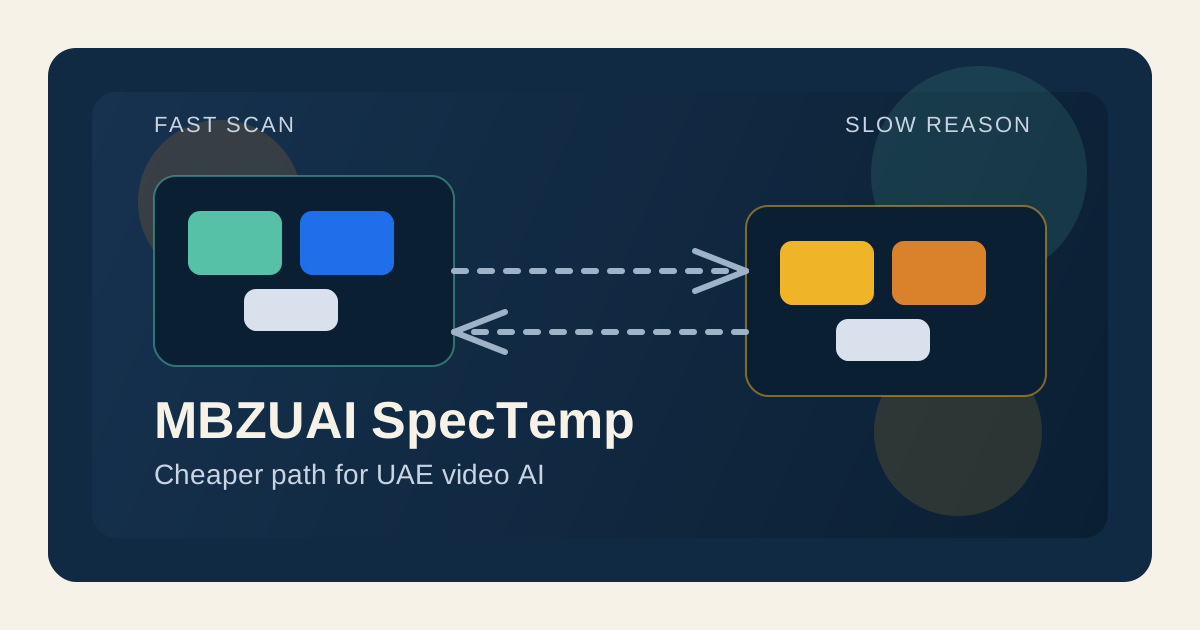
The university said its researchers had developed a video-understanding framework that separates fast visual scanning from slower reasoning, reducing inference latency by about 20% across a set of benchmarks while maintaining competitive accuracy. The underlying paper, Thinking with Drafts: Speculative Temporal Reasoning for Efficient Long Video Understanding, was accepted to CVPR 2026.
This is not a product launch.
It is a research signal from Abu Dhabi about one of the most practical constraints in applied AI: how to make video reasoning less wasteful.
The direct answer
This matters because many UAE organisations want AI systems that can review footage, spot events, answer questions about long videos, or support operators in real time, but the compute cost of doing that well can rise quickly.
For professionals, leaders, enterprises, and government teams in the UAE, the practical implication is:
- the market may not need to rely only on ever-larger video models and ever-higher compute budgets
- more efficient video AI could widen the range of use cases that are commercially realistic
- deployment readiness will depend on workflow design and escalation logic, not only model size
- AI capability-building will need to include multimodal operations, evaluation, and cost discipline
In short, this is a useful Abu Dhabi signal about inference economics.
What MBZUAI actually announced
According to MBZUAI's article, today's large multimodal video systems often process many visual tokens that end up contributing little to the final answer.
The university said its researchers inspected one standard approach and found that about 90% of visual tokens received attention scores below 0.001, suggesting much of the computation was being spent on information that the model barely used.
SpecTemp is the university's answer to that waste.
In MBZUAI's description:
- a larger
7Btarget model handles the higher-level reasoning - a smaller
3Bdraft model scans dense video segments to find the most informative frames - the two models work in a loop, with the larger model deciding when it needs closer inspection and the smaller model returning only a few key frames
- the process can repeat for up to three rounds
The public article says the system was tested across eight benchmarks ranging from short clips to videos of about an hour. MBZUAI reported roughly a 20% reduction in inference latency with no loss in accuracy, plus modest gains on several long-form tasks.
The arXiv paper adds that the team built a SpecTemp-80K dataset with dual-level annotations to train the system and used reinforcement learning to teach the two models to cooperate.
That is the meaningful part for the market.
The work is not trying to prove that bigger context windows solve everything. It is arguing that perception and reasoning are different jobs and should not always be handled by the same expensive model path.
Why this matters in the UAE now
The UAE has a growing number of environments where video AI is relevant:
- mobility and transport operations
- smart-city and public-service monitoring
- industrial inspection and safety workflows
- ports, logistics, and warehouse operations
- healthcare imaging and clinical review support
- retail, hospitality, and customer-experience analytics
In many of those settings, the issue is not whether video data exists.
The issue is whether the organisation can process enough of it, quickly enough, and cheaply enough, to make the workflow sustainable.
That is why this MBZUAI announcement matters more than a generic model headline.
It points at an operational bottleneck that UAE buyers, public-sector teams, and delivery leaders will run into as soon as video AI moves from demo mode to scaled use.
The real market implication is cost-adjusted adoption
For AiRK's audience, the important reading is not "video AI is solved."
The important reading is that Abu Dhabi researchers are working on how to reduce the cost of reasoning over long video while preserving performance.
That can matter in the UAE because many real deployments have to balance:
- compute cost
- response speed
- operator trust
- data-governance constraints
- human-review requirements
A system that can examine video more selectively may help organisations think more carefully about where full model reasoning is needed and where faster screening is enough.
That is also increasingly relevant to agentic workflows. In practice, many AI systems will need to decide when to escalate, when to request more evidence, and when to stop processing. SpecTemp is not a full enterprise agent, but it does model that kind of staged decision pattern.
What leaders should pay attention to
Leaders in the UAE should read this as a prompt to ask better deployment questions:
- which video-heavy workflows genuinely need AI reasoning instead of basic detection
- where compute cost is blocking wider deployment
- whether the team can separate screening, evidence selection, and final decision-making
- how latency targets affect operational usefulness
- what human oversight is required before an AI conclusion becomes an action
Those questions matter in regulated, safety-sensitive, and public-facing environments where a technically impressive demo can still fail operationally.
What this means for professionals and AiRK's audience
For professionals, the signal is that multimodal AI work is becoming more about system design than raw model access.
The useful skills here include:
- mapping a video use case to a staged workflow
- understanding where inference cost actually accumulates
- deciding when smaller models can screen or triage before a larger model reasons
- evaluating latency, throughput, and error tradeoffs
- designing human review paths for ambiguous outputs
That applies to technical teams, digital-transformation managers, operations leaders, analysts, and public-sector professionals alike.
The workforce value is moving toward people who can make AI systems economical and dependable inside real workflows.
What not to overclaim
It is important to keep the conclusion narrow.
MBZUAI announced a research result, not a UAE-wide deployment. The public material does not claim production rollouts across ministries or enterprises. It does not prove that all long-video use cases will become cheap. It also notes open questions around more resource-intensive training and multi-hour video performance.
So the disciplined conclusion is this:
SpecTemp does not prove that video AI in the UAE is suddenly easy.
What it does show is that Abu Dhabi's research ecosystem is focusing on a practical deployment problem that many organisations will face soon: how to get useful video reasoning without paying the full cost of brute-force processing every frame.
That is a meaningful market signal.
AiRK view for the UAE market
The next stage of UAE AI adoption will depend not only on what models can do, but on what organisations can afford to run reliably.
That is why MBZUAI's June 2026 SpecTemp update matters.
It suggests a more disciplined path for video AI in the UAE, where systems can screen first, investigate selectively, and spend serious compute only where it adds value.
For enterprises, that could improve the business case for multimodal operations. For government teams, it sharpens the conversation around throughput, response time, and oversight. For professionals, it is another reminder that practical AI capability now includes cost-aware system design, not just prompting or tool familiarity.
That makes this more than a lab result. It is a useful signal about how Abu Dhabi is helping the UAE market think more operationally about multimodal AI.