
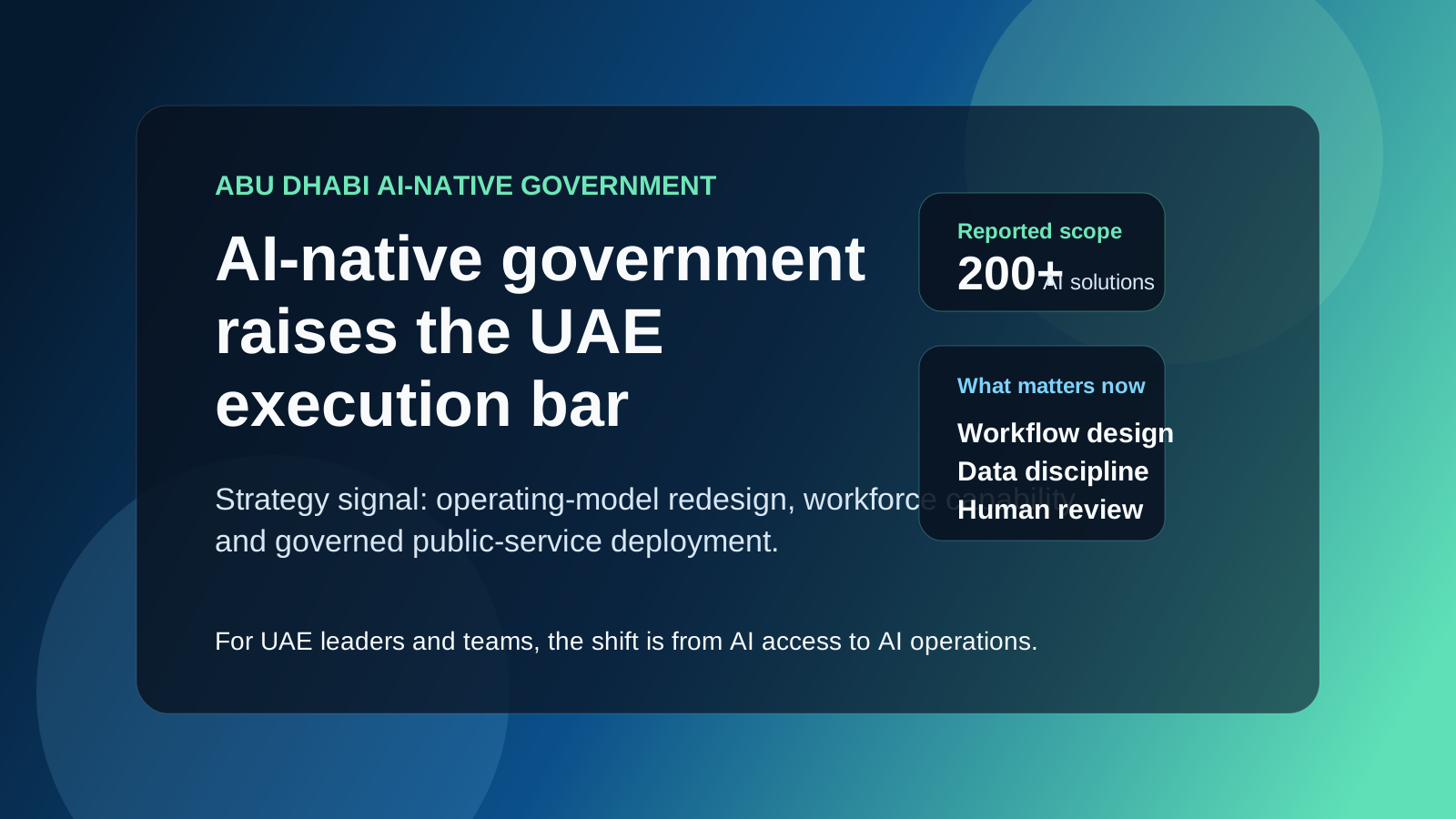
Abu Dhabi's AI-native government strategy raises the execution bar for every UAE team
Abu Dhabi's reported Government Digital Strategy 2025-2027 matters because it pushes the UAE AI conversation beyond pilots and into AI-native public operations, with practical implications for leaders, enterprise teams, government operators, and workforce training.
The UAE already has no shortage of AI headlines.
There are frontier-model announcements, sovereign-infrastructure deals, new committees, workforce programmes, and public-sector pilots.
What matters now is which institutions are trying to redesign how they operate, not just which ones are experimenting.
That is why Abu Dhabi's reported Government Digital Strategy 2025-2027 is worth attention. Public reporting on 19 May 2026 said the emirate plans to become the world's first fully AI-native government, backed by a multi-year investment plan, a target to automate large parts of government processes, and an "AI for All" capability push across government staff.
Even with limited public implementation detail so far, that is a serious market signal.
It suggests Abu Dhabi is treating AI less like a departmental tool rollout and more like operating infrastructure for government itself.
The direct answer
This matters because it raises the execution bar for the whole UAE market.
If Abu Dhabi is serious about AI-native government, the practical implications are:
- government teams will need stronger process design, data quality, exception handling, and human-review controls
- enterprise vendors and delivery partners will face more pressure to support implementation, not just demos
- leaders will need clearer AI operating models, not only strategy decks or broad transformation language
- professionals with workflow, governance, and change-enablement skills will become more valuable than people who only know AI tools at surface level
The useful reading is not "Abu Dhabi has already automated government."
The useful reading is that the emirate is signalling where public-sector AI expectations may head next: AI embedded into operating systems, service delivery, and workforce routines.
What has been publicly reported
The 19 May 2026 reporting tied the strategy to Abu Dhabi's Department of Government Enablement and described a planned investment of AED 13 billion through 2027.
The same report said the strategy includes:
- more than 200 AI-powered solutions across government services
- automation of large shares of internal government processes
- an aim to save hundreds of millions of annual working hours
- an "AI for All" programme designed to build practical capability across the government workforce
Those details matter because they frame AI as an operating model, not just a set of pilot applications.
That is a different level of ambition from introducing a chatbot, trialling copilots, or adding AI features inside a single function.
Why this is different from a generic digital-transformation story
Many public-sector digital programmes still leave core work unchanged.
They digitise forms, add portals, or improve access, but the underlying workflow logic remains mostly human, fragmented, and slow.
An AI-native government strategy implies something more demanding.
It implies that teams will need to revisit:
- where decisions are made
- where data enters and breaks
- which approvals can be accelerated
- which steps need mandatory human oversight
- how service quality is measured after AI is introduced
That is why this topic matters beyond government.
It describes the kind of redesign pressure that eventually reaches enterprise shared services, regulated operations, internal support teams, and external delivery partners too.
Why Abu Dhabi's institutional context matters
Abu Dhabi is not starting from zero.
The emirate already operates through large digital-service surfaces such as TAMM, and it has spent years building central coordination through entities focused on government enablement, data, and digital delivery. That means an AI-native government agenda in Abu Dhabi is more credible than the same language would be in a less digitally mature environment.
The context also matters because the UAE's federal AI direction has been getting more operational. On 20 May 2026, the UAE Government announced its first integrated AI ecosystem with AI agents, a unified data framework, and a training ambition covering 80,000 government employees.
Seen together, the federal move and the Abu Dhabi strategy point in the same direction.
The question is shifting from whether government should use AI to how government should structure AI safely at scale.
What leaders should pay attention to now
The market lesson is not to copy government headlines.
It is to understand the operating requirements beneath them.
Leaders in government entities, large enterprises, and government-linked organisations should be asking:
- which workflows are stable enough to automate or augment
- where human sign-off must remain non-negotiable
- whether internal data is clean enough for production AI use
- which teams need role-based AI training rather than generic awareness sessions
- how performance, risk, and accountability will be measured after deployment
These are not technical side questions. They are the real work of implementation.
What this means for enterprise teams and vendors
For private-sector operators, Abu Dhabi's AI-native government push is also a procurement and capability signal.
If public institutions move toward AI-native workflows, they will need partners that can help with:
- workflow mapping and prioritisation
- service-design changes before automation
- governed document and knowledge flows
- model oversight, audit trails, and escalation rules
- workforce enablement tied to real roles
That favours firms that can connect AI to operating discipline.
It is less helpful for vendors whose proposition depends on generic productivity claims or abstract transformation messaging.
What this means for professionals and AiRK's audience
For professionals in the UAE, the most important lesson is simple.
The labour-market premium is moving toward applied execution.
As AI adoption becomes more operational, valuable people will be the ones who can:
- redesign a workflow rather than merely prompt inside it
- spot where AI output needs review, escalation, or refusal
- document governance choices clearly
- train teams around actual tasks and risk boundaries
- connect AI deployment to service or productivity outcomes
This is where AI education becomes more demanding.
Teams need less generic enthusiasm and more capability in process analysis, human-in-the-loop design, policy interpretation, and responsible adoption.
That is especially relevant for government teams, regulated sectors, enterprise functions, and internal training leads.
What not to overclaim
The public record still has limits.
At the time of writing on 10 June 2026, the widely cited details around Abu Dhabi's Government Digital Strategy 2025-2027 are clearer on ambition than on implementation milestones.
We do not yet have a full public breakdown of:
- which services will move first
- which AI systems are already live
- what performance baselines are being used
- how agency-by-agency governance will be enforced
- how the reported time-savings assumptions will be measured in practice
So the disciplined conclusion is narrower.
Abu Dhabi has signalled a serious AI-native government direction. That does not prove full execution yet, but it does raise expectations for how the UAE market will think about service design, public-sector delivery, and AI workforce readiness.
AiRK view for the UAE market
This is the part of the UAE AI story worth watching closely.
The durable winners in the next phase will not just be the teams with model access. They will be the teams that can take AI ambition and turn it into governed, repeatable work.
For leaders, that means better operating design. For enterprises, it means implementation capability. For government teams, it means stronger data and review discipline. For professionals, it means role-based AI fluency tied to real tasks and judgment.
That is why Abu Dhabi's AI-native government strategy matters even before the full execution picture is public. It pushes the conversation toward the harder question: who can actually run AI well inside important institutions?