
MBZUAI's 2026 commencement turns Abu Dhabi's AI talent story into a deployment signal
MBZUAI's 8 May 2026 commencement matters because it shows the UAE's AI ecosystem producing a larger, more employment-linked talent pipeline at the same time enterprises and government teams are demanding practical AI operators, engineers, and leaders.
The UAE has spent most of 2026 talking about AI infrastructure, sovereign deployment, governance, and government transformation.
Those shifts matter. But none of them scale without people.
That is why MBZUAI's 2026 commencement is worth reading as more than a university ceremony.
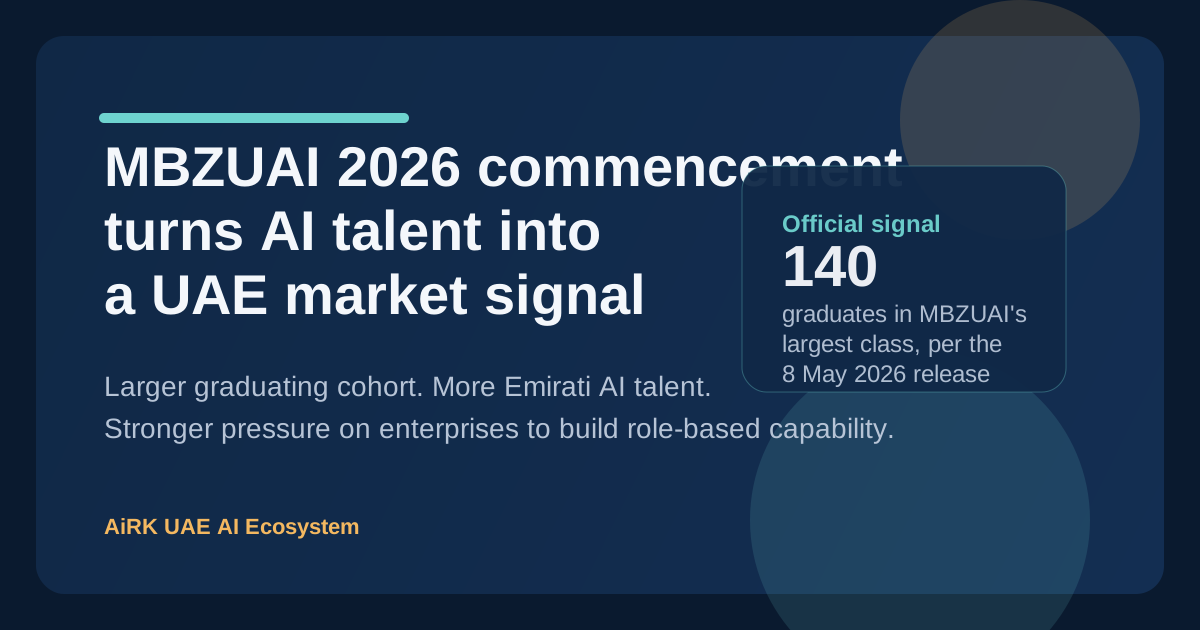
On 8 May 2026, MBZUAI said its fifth and largest graduating class since launch included 140 graduates from 23 countries across computer science, computer vision, machine learning, natural language processing, and robotics. The same official release said the Class of 2026 included 30 Emirati graduates, and that alumni from the cohort were heading into organisations including ADNOC, Presight, Meta, Tesla, and Bloomberg, as well as top research placements.
For the UAE market, that is a practical ecosystem signal. Abu Dhabi is not only attracting AI ambition. It is producing a larger pipeline of deployable AI talent that can move into energy, government, enterprise software, research, and regulated sectors.
The direct answer
This matters because the UAE's AI story is becoming more execution-dependent.
For professionals, leaders, enterprises, and government teams, the practical implications are:
- the market increasingly values people who can build, deploy, and supervise AI inside real organisations
- AI talent is spreading beyond pure research into sector-linked roles across energy, public administration, finance, healthcare, and technology
- workforce planning is becoming as important as model access, compute, or vendor selection
- organisations that rely only on external tools without building internal capability will struggle to turn AI ambition into repeatable outcomes
In short, the UAE's AI bottleneck is moving from awareness to capability depth.
What MBZUAI officially put on the record
MBZUAI's 8 May 2026 commencement release framed the university as part of the UAE's national AI talent engine. The university said the graduating cohort was its largest yet, and linked that output directly to the country's digital-transformation and knowledge-economy goals.
Two details matter most.
First, the talent mix is broad. The graduating class spans the technical disciplines that sit underneath most serious enterprise AI work: models, language, perception, robotics, and systems.
Second, the placement signal is practical. MBZUAI did not describe graduates only as future researchers. It pointed to destination organisations across industry and frontier technology, including ADNOC and Presight in the UAE ecosystem, alongside global technology employers and research institutions.
That makes this an operating-market signal, not just an academic one.
Why this matters more now
The timing is important.
Over the past six weeks, the UAE market has produced repeated signals that AI is moving deeper into live operations:
- federal and Dubai government teams are building larger agentic AI and workforce-transformation programmes
- regulated sectors such as healthcare and finance are adding stronger governance expectations
- infrastructure and sovereign-AI announcements are pushing organisations closer to production deployment
Once that happens, the talent requirement changes.
The market no longer only needs prompt users or innovation champions. It needs more people who can do things such as:
- translate a business workflow into an AI-assisted process
- connect models to data, systems, and approval steps
- monitor quality, risk, and escalation paths after launch
- understand where human review must stay in place
- help leaders make realistic decisions about rollout, staffing, and governance
That is why a larger, more sector-linked graduating class matters.
The broader UAE demand picture supports the signal
MBZUAI's own AI Graduate Employment Landscape in the UAE report makes the context clearer.
The report says demand for AI-qualified talent is spreading across finance, healthcare, government services, agriculture, construction, ICT, transport, education, retail, and tourism. It also says the biggest current UAE job categories include data scientists and analysts, AI engineers, software and systems developers, machine-learning engineers, product and project managers, and AI leadership roles.
That is a useful corrective to how many organisations still talk about AI hiring.
The demand is not only for frontier researchers. It is also for:
- technical implementers
- workflow owners with AI literacy
- managers who can operationalise AI
- specialists who can combine domain knowledge with model understanding
- trainers and internal capability-builders
This is exactly where many UAE organisations still have gaps.
What leaders should take from it
Leaders should not read this as a reason to assume the talent problem is solved.
The better reading is narrower. The UAE is improving the talent pipeline, but the market is also becoming more demanding.
MBZUAI's employment report says companies expect a much larger share of employees to become AI-qualified within three years, while also highlighting retention pressure, shortages in practical skills, and the need for stronger university-industry collaboration. It also notes that employers care about hands-on experience, not theory alone.
That means enterprise and government leaders should act accordingly:
- Separate AI awareness roles from AI implementation roles.
- Build role-based learning paths for managers, operators, analysts, and technical teams.
- Hire for practical workflow ownership, not only for impressive model vocabulary.
- Pair external recruitment with internal upskilling if retention and availability stay tight.
- Treat AI capability-building as an operating investment, not a side HR initiative.
That is a more defensible response than assuming the market will simply supply ready-made AI teams on demand.
What this means for professionals
For professionals in the UAE, the signal is encouraging but demanding.
There is clearly more room in the market for AI-linked careers. But the highest-value profile is changing.
The stronger position is not to be "interested in AI." It is to be useful in one of these combinations:
- AI plus operations
- AI plus finance
- AI plus healthcare
- AI plus government service delivery
- AI plus product or engineering execution
- AI plus governance and risk
MBZUAI's report is explicit that employers still want fundamentals, technical skills, practical application, and business acumen together. That is especially relevant for AiRK's audience, because many professionals will not become research scientists. They will become the people who help organisations actually use AI safely and well.
Why this matters for AiRK's audience
For an AI training company, this is one of the clearest recent UAE signals that the market is maturing.
The opportunity is no longer limited to introductory AI exposure. The UAE ecosystem increasingly needs training that helps people:
- map AI to real workflows
- manage approvals and human review
- handle sensitive data more carefully
- evaluate vendors and system choices
- move from pilot usage to governed deployment
That applies across public entities, large enterprises, SMEs, and sector teams.
The most useful training outcome in this market is not inspiration. It is practical competence.
What not to overclaim
This development should still be read with discipline.
A larger MBZUAI graduating class does not mean the UAE has solved its AI talent gap. It does not prove every graduate will stay in the local market long term. It does not remove the need for retraining existing workforces, especially in non-technical departments.
It also does not mean every organisation is ready to absorb advanced AI talent properly. In many cases, the bigger problem is still weak workflow design, unclear ownership, and poor change management.
So the right conclusion is more specific.
Abu Dhabi is producing a more visible AI talent pipeline at a time when UAE demand is broadening from research and hype into sector-based execution. That is a meaningful ecosystem development because it improves the country's ability to staff the harder phase of AI adoption.
AiRK view for the UAE market
MBZUAI's 2026 commencement matters because it shows a more complete UAE AI ecosystem taking shape.
The country is not only funding AI, regulating AI, or buying AI infrastructure. It is also producing more of the people who will need to make AI useful inside institutions.
For leaders, that raises the standard for workforce planning. For professionals, it raises the value of domain-linked AI competence. For government and enterprise teams, it reinforces a simple reality: the organisations that win in UAE AI will not just have access to tools. They will have people who know how to deploy them responsibly in real work.