
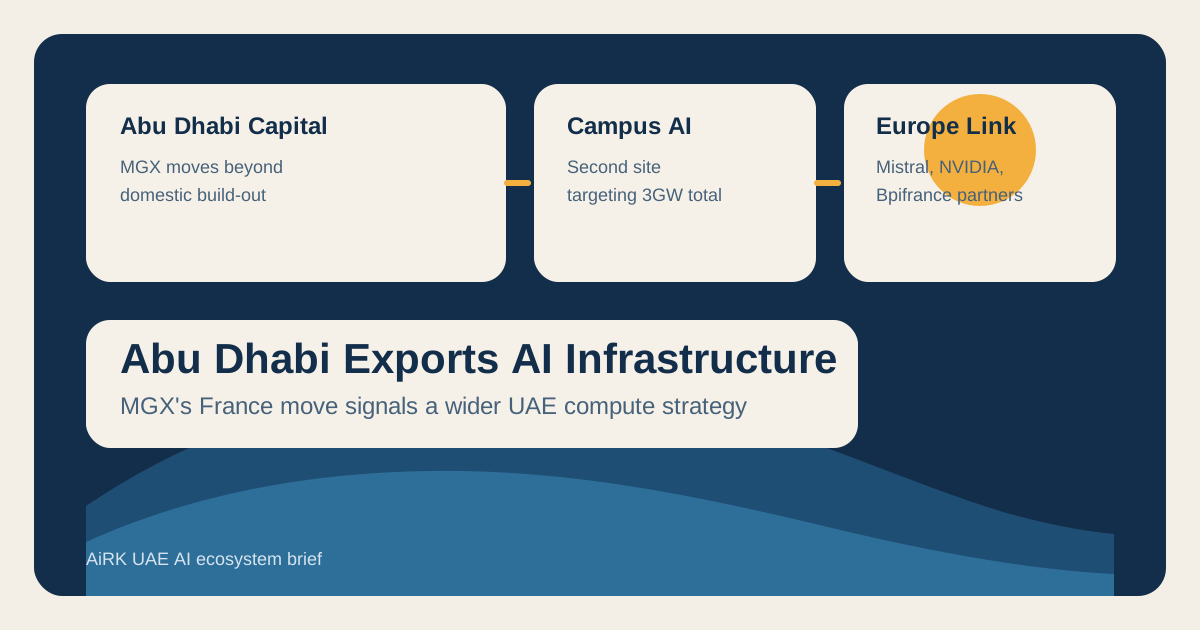
MGX's France expansion shows Abu Dhabi exporting AI infrastructure strategy
MGX's 1 June 2026 Campus AI expansion in France matters for the UAE AI ecosystem because it shows Abu Dhabi moving beyond domestic build-out and into exporting capital, compute strategy, and AI infrastructure influence across markets.
One of the more important UAE AI ecosystem signals this week did not happen inside the UAE.
It happened in France.
On 1 June 2026, the Abu Dhabi Media Office announced that Campus AI, backed by MGX, Mistral AI, NVIDIA, and Bpifrance, would expand with a second site in Eybens near Grenoble. The official update said the expansion would create up to 1.4 gigawatts of additional AI computing capacity, bringing the wider project to around 3 gigawatts.
That matters for the UAE because it shows Abu Dhabi's AI strategy maturing into something larger than domestic capability-building. Through MGX, Abu Dhabi is now participating in how major AI infrastructure gets financed and shaped outside its own borders.
The direct answer
The practical reading is that Abu Dhabi is starting to export an AI infrastructure playbook, not only build one at home.
That is important because the UAE AI story is often described through local ingredients:
- sovereign compute
- frontier-model research
- government AI adoption
- capital formation
- sector pilots
Those are still real. But MGX's France move suggests the next phase is outward-facing. Abu Dhabi is using capital and strategic partnerships to influence where large-scale AI infrastructure gets built, who participates in it, and how the wider compute map evolves.
For UAE leaders, professionals, and enterprise teams, that changes the market context. The ecosystem is no longer only consuming global AI infrastructure. It is helping shape it.
What was actually announced on 1 June 2026
According to the Abu Dhabi Media Office, MGX and its partners are expanding Campus AI, described as Europe's largest AI campus, with a second location in Eybens. The announcement says the site will be developed in collaboration with Atos and regional public-sector partners, and that the full initiative is expected to support around 3 gigawatts of AI computing capacity.
The official announcement also matters because of the partner set.
MGX represents Abu Dhabi's AI investment engine. Mistral AI brings a major European frontier-model company into the project. NVIDIA anchors the compute stack. Bpifrance and French regional partners add state-backed industrial and financing support on the European side.
This is not a generic innovation memorandum. It is an infrastructure alignment deal involving capital, energy-intensive compute planning, and long-term industrial positioning.
Why this matters for the UAE AI market
The UAE has spent the last few years strengthening its AI identity through research institutions, compute infrastructure, major investment vehicles, and government deployment. Most local analysis stops there.
This announcement adds another layer.
It suggests Abu Dhabi wants a role in the international geography of AI infrastructure, not only in the local deployment of AI systems. That matters because influence in AI increasingly sits in a few linked layers:
- model capability
- compute access
- financing power
- deployment ecosystems
- talent and operating know-how
MGX is already active in the capital layer. The France announcement shows how that capital can be used to shape infrastructure ecosystems abroad while reinforcing Abu Dhabi's position as a serious AI actor.
For the UAE market, the implication is that AI strategy is becoming more global and more infrastructural at the same time.
Why this is more than a finance story
It would be too narrow to read this only as an investment headline.
Large AI campuses matter because they influence who gets access to high-performance compute, where advanced workloads can be trained and served, and which regions become attractive for model developers, infrastructure vendors, and enterprise AI operators.
That has practical consequences for UAE organisations.
If Abu Dhabi-linked institutions are participating in major cross-border infrastructure projects, then the UAE ecosystem gains more than reputation. It gains exposure to:
- large-scale compute planning
- infrastructure partnerships
- energy and data-centre operating models
- commercial patterns around AI capacity
- international standards for enterprise-grade AI environments
Those lessons eventually feed back into the local market, even when the asset itself is overseas.
What leaders should pay attention to now
For enterprise and government leaders in the UAE, the main lesson is that AI competitiveness is becoming more structural.
The old question was often, "Which model should we use?"
The better question now is, "What infrastructure, governance, and delivery position do we need if AI becomes a long-term operating dependency?"
Announcements like this matter because they show where sophisticated players are placing their attention. They are not focusing only on applications and copilots. They are also investing in the physical and financial layers that determine who can build and scale AI systems reliably.
That does not mean every UAE organisation needs to think like MGX. It does mean leadership teams should stop treating AI as only a software procurement category.
What this means for professionals and AiRK's audience
For professionals, this kind of development is a reminder that the UAE AI market is broadening beyond prompts, tools, and lightweight automation.
There will still be strong demand for practical user-level AI capability. But the market is also rewarding people who understand the layers around deployment:
- infrastructure constraints
- sovereign and regional hosting choices
- vendor evaluation
- AI economics
- governance tradeoffs
- implementation sequencing
For AiRK's audience, that creates a clearer skills opportunity. People who can connect AI adoption decisions to compute realities, policy environments, cost structure, and workflow design will become more valuable than people who only know how to use surface-level tools.
Why this fits MGX's wider pattern
This is also consistent with MGX's broader 2026 direction.
In late May 2026, MGX said its board had reviewed a strategy spanning frontier AI, infrastructure, and applications, with contracted and committed capacity projected beyond 8 gigawatts. That earlier update showed scale and ambition. The France announcement shows how that strategy is turning into concrete international infrastructure positioning.
Taken together, the two signals point to a narrower but stronger conclusion: Abu Dhabi is not only backing AI as a national technology priority. It is building leverage in the capital-and-infrastructure layer that will shape how AI develops across regions.
What not to overclaim
This announcement does not mean the UAE controls European AI infrastructure, and it does not prove that the full projected capacity will be delivered on the announced timeline.
It also does not directly tell us how much of the operational benefit will flow back into the UAE market, or how local enterprises will access any capability created through this initiative.
So the right conclusion should stay disciplined.
The defensible point is that Abu Dhabi, through MGX, is extending its AI strategy beyond local market development and into cross-border infrastructure influence. That is a meaningful ecosystem shift even without overstating the immediate commercial outcomes.
AiRK view for the UAE market
MGX's France expansion matters because it shows the UAE AI ecosystem entering a more mature phase.
The country is still building local capability in training, regulation, sector adoption, and enterprise execution. But alongside that, Abu Dhabi is also placing itself in the global infrastructure layer that underpins AI power.
For leaders, that means AI strategy should be read with more seriousness at the infrastructure and operating-model level. For professionals, it means the most durable AI skills will increasingly include judgment about systems, governance, and scale, not only tool use. And for the wider UAE market, it is another sign that Abu Dhabi wants to help shape the AI economy, not only participate in it.