
MBZUAI's UNICON move signals a bigger UAE market for executive AI capability
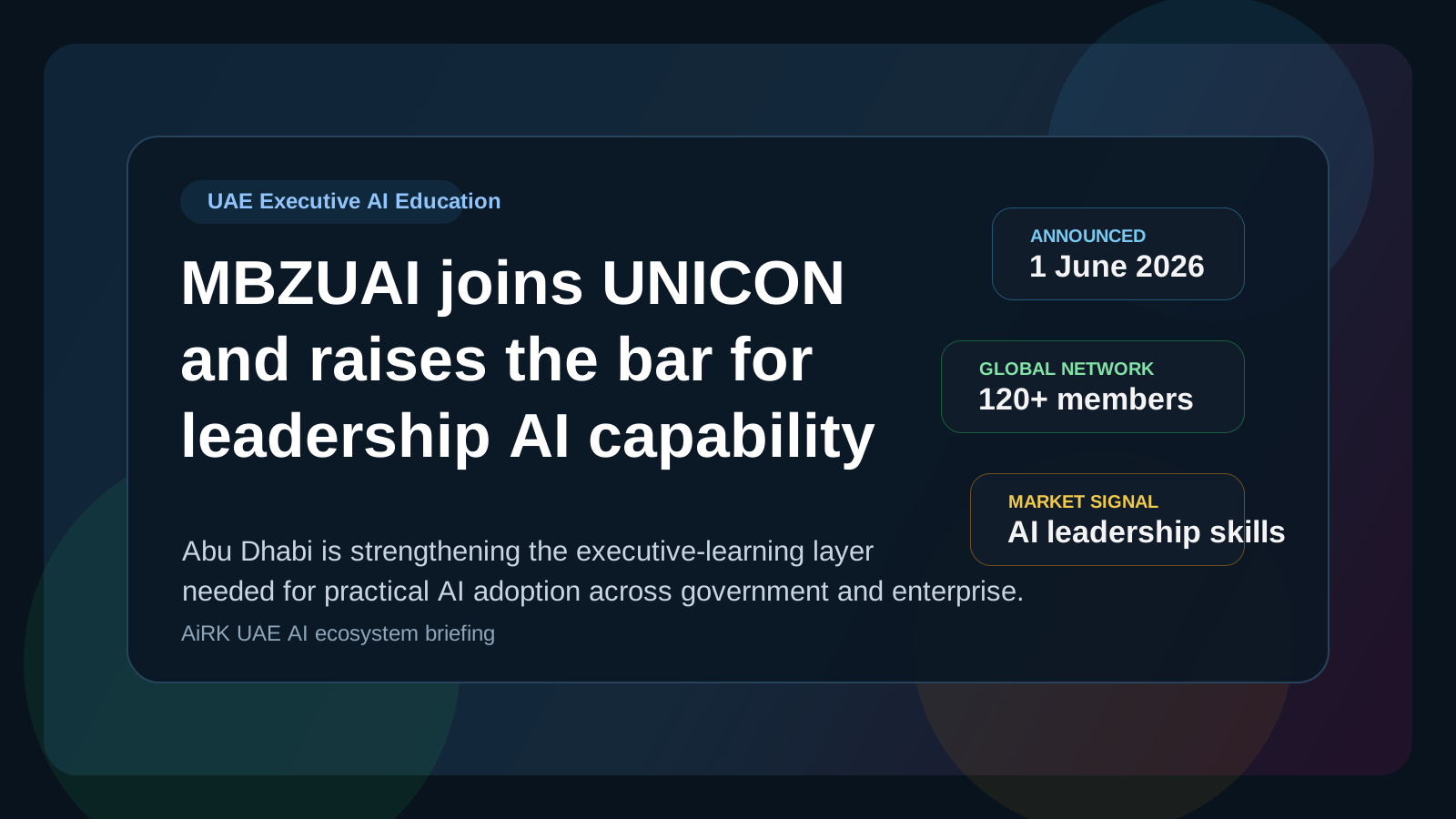
MBZUAI's 1 June 2026 entry into the UNICON executive-education network matters for the UAE AI ecosystem because it shows Abu Dhabi strengthening the leadership and workforce layer needed to turn AI ambition into disciplined organisational execution.
One of the more useful UAE AI signals this week is not a new model, a funding round, or a regulation.
It is an executive-education move.
On 1 June 2026, Mohamed bin Zayed University of Artificial Intelligence announced that it had joined UNICON, a global network of universities and institutions focused on executive education. On its own, that can sound like a membership update. In practice, it is more important than that for the UAE market.
The reason is simple: serious AI adoption now depends less on basic awareness and more on whether leaders, managers, and transformation teams know how to govern, prioritise, buy, deploy, and reshape work around AI.
That is the layer this announcement strengthens.
The direct answer
MBZUAI joining UNICON is a signal that Abu Dhabi is professionalising the executive-learning part of its AI ecosystem, not just the research and infrastructure part.
That matters because the UAE already has many of the visible top-layer ingredients of an AI ecosystem:
- government strategy
- frontier-model research
- sovereign AI infrastructure
- startup formation
- sector pilots
The next constraint is often operational leadership. Many organisations no longer need convincing that AI matters. They need leaders who can make sound implementation decisions.
That is why this announcement is relevant to enterprise teams, government departments, regulated sectors, and training providers.
What was actually announced on 1 June 2026
According to MBZUAI, the university and its executive-education arm, The Academy, have joined UNICON, a network of more than 120 business schools and executive-education providers worldwide. MBZUAI said the membership strengthens its position in professional and leadership development and gives The Academy more opportunity to benchmark against international peers and expand partnerships.
MBZUAI also framed the move around rising demand for AI-related executive education. That framing is important. The announcement was not presented as a general university brand exercise. It was presented as part of a market for leadership upskilling tied directly to AI adoption.
UNICON's own site separately listed MBZUAI among its new members on 29 May 2026, which supports the institutional significance of the move.
Why this matters in the UAE, not just inside one university
The UAE AI story is often told through national strategy, major labs, and capital deployment. Those matter, but they do not solve the leadership bottleneck inside organisations.
Most AI programmes fail or stall for reasons that sit above the model layer:
- weak use-case selection
- poor process design
- unclear ownership
- governance that appears too late
- unrealistic vendor expectations
- leaders who sponsor AI without changing incentives or workflows
Executive education is where many of those problems get addressed before they become procurement waste or internal confusion.
That is why MBZUAI's UNICON entry matters as an ecosystem signal. It suggests Abu Dhabi is trying to improve the quality, credibility, and international benchmarking of the people who will make AI decisions across organisations, not only the researchers who build core systems.
The Academy makes this more than a symbolic membership
This story would be weaker if MBZUAI had no visible executive-learning platform behind it.
But The Academy already exists as a dedicated executive and thought-leadership arm. Its public site says it has trained more than 10,000 professionals, delivered more than 130 upskilling initiatives, and graduated 292 government and industry leaders. It offers executive programmes, briefings, and leadership-focused AI learning rather than only full academic degrees.
That makes the UNICON announcement easier to read as an operating-market signal rather than a ceremonial affiliation.
In other words, this is not just Abu Dhabi saying executive AI education matters. It is Abu Dhabi placing an existing delivery platform into a global executive-education network at a time when AI capability is becoming a leadership requirement.
Why leaders should pay attention
For UAE business and government leaders, the practical implication is that AI capability is becoming more structured and less improvised.
That changes expectations.
In the early wave of adoption, many organisations treated AI learning as short experimentation: a workshop, a tool demo, a few pilot champions, and scattered prompting sessions.
That is no longer enough for organisations trying to deploy AI in procurement, finance, customer operations, compliance, HR, healthcare, education, or public services.
Leaders increasingly need to understand:
- where AI fits into operating models
- which workflows should be redesigned first
- how to govern internal use without blocking adoption
- how to assess claims from vendors and system integrators
- what workforce capability needs to exist before automation scales
An executive-learning layer that is tied into a global network raises the standard for those conversations.
What this means for professionals and AiRK's audience
For professionals, the labour-market implication is clear.
The UAE does not only need more AI engineers. It also needs more AI-literate managers, transformation leads, function heads, policy teams, and implementation specialists who can connect technical possibility with business reality.
That creates demand for people who can do things such as:
- translate strategy into scoped AI initiatives
- evaluate risk and governance tradeoffs early
- run structured pilots with measurable outcomes
- redesign team workflows around human review and automation
- communicate AI limits clearly to executives and staff
This is exactly where practical AI training becomes more valuable than generic AI enthusiasm.
For AiRK's audience, the message is that the UAE market is maturing toward role-based, decision-linked AI capability. The question is not only who can use AI tools. It is who can lead responsible adoption inside real institutions.
Why this is a stronger signal than a normal partnership item
There are three reasons this stands out.
First, the announcement is recent, dated 1 June 2026, and comes from a primary institution at the centre of Abu Dhabi's AI ecosystem.
Second, it aligns with MBZUAI's broader 2026 pattern. In recent weeks the university has expanded government-facing applied AI education and industry-linked programmes, showing that its role is widening beyond research degrees alone.
Third, it lands at a moment when the wider UAE market is moving from AI interest to AI operating discipline. In that environment, executive education is not an accessory. It becomes infrastructure for adoption quality.
What not to overclaim
This does not mean the UAE has solved executive AI capability gaps.
It does not prove that membership alone will improve outcomes inside government or enterprise teams. It also does not show how many new programmes, partnerships, or learners will result directly from the move.
And UNICON membership is not the same as broad market transformation.
The narrower and more defensible conclusion is that Abu Dhabi is strengthening a serious institutional channel for leadership-level AI education, using global executive-education benchmarking rather than only local signalling.
AiRK view for the UAE market
MBZUAI joining UNICON is a meaningful UAE AI ecosystem development because it sharpens a part of the market that is often overlooked: leadership capability.
The next stage of AI adoption in the UAE will not be won only by whoever has the best model access or the biggest compute narrative. It will also be shaped by which organisations build leaders who can make good AI decisions under real operating constraints.
For professionals, that means learning how AI affects process design, risk, governance, and execution. For enterprises and government teams, it means treating executive AI education as part of implementation readiness, not as a side activity. And for the broader UAE ecosystem, it suggests Abu Dhabi is still building the institutional muscle needed to turn AI ambition into repeatable organisational performance.