
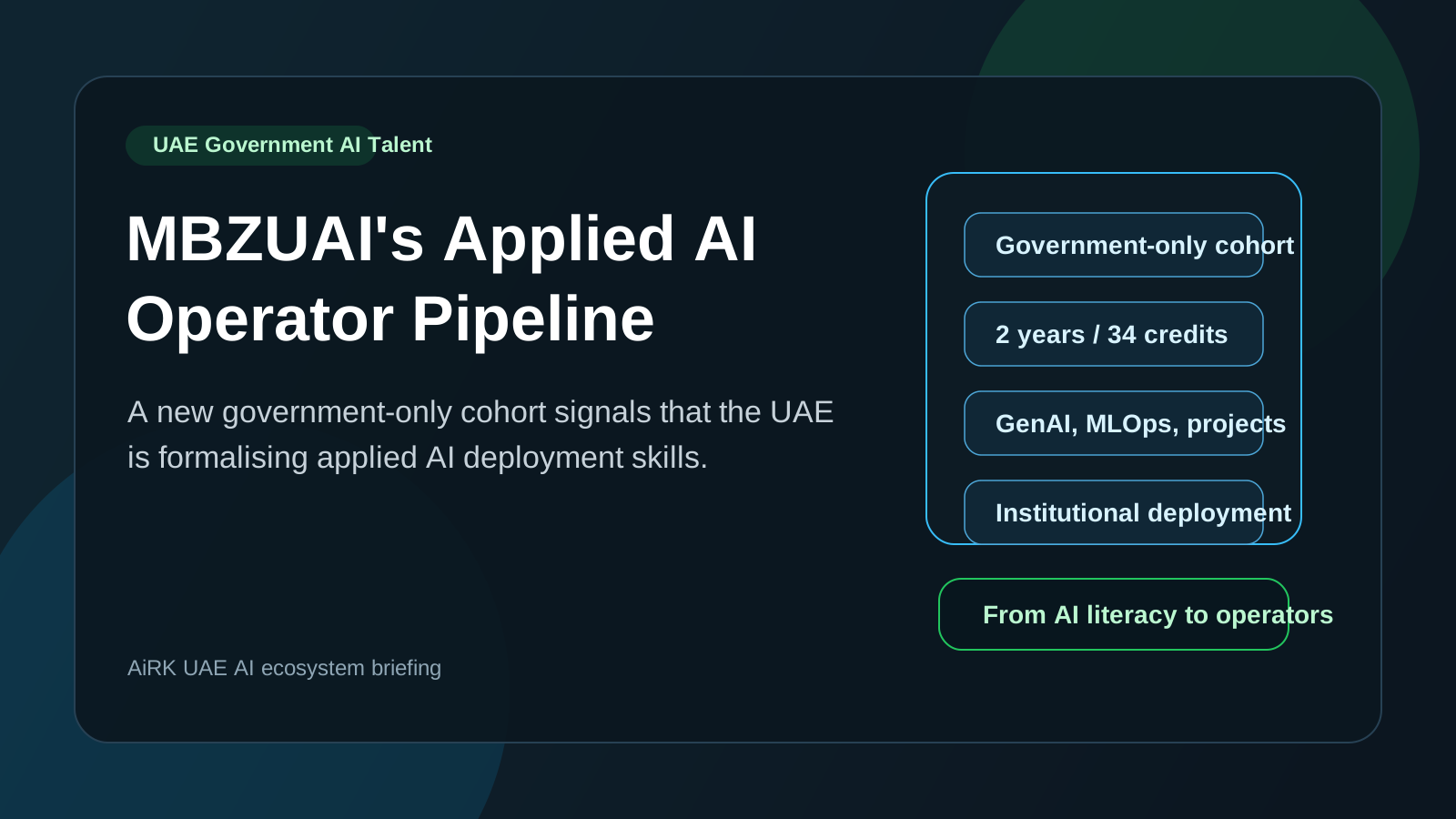
MBZUAI's new government-only Applied AI cohort shows how the UAE is building AI operators
MBZUAI's 22 May 2026 launch of a government-only Master's in Applied AI cohort under the Mohammed bin Rashid Government Scholarships is a practical UAE signal: AI capability-building is moving from short courses and pilots into formal, role-linked operator training.
The UAE's AI story is getting more institutional.
On 22 May 2026, Mohamed bin Zayed University of Artificial Intelligence said it welcomed a new cohort into its Master in Applied Artificial Intelligence through the Mohammed bin Rashid Government Scholarships. The detail that matters most is not only that the programme exists. It is that the inaugural cohort is made up exclusively of UAE government employees and is tied to a formal scholarship pathway launched on 1 May 2026 for specialised government talent.
That makes this more than a higher-education update. It is a market signal that the UAE is starting to build applied AI capability through structured, role-linked education rather than relying only on broad awareness programmes or ad hoc experimentation.
The direct answer
This development matters because it shows the UAE treating AI capability as an operating function that needs deeper professional preparation.
For professionals, leaders, enterprises, and government teams, the implication is straightforward:
- the market is rewarding people who can deploy AI inside real institutions, not only discuss it
- AI training is moving closer to production workflows, governance, and leadership responsibility
- public-sector AI adoption in the UAE is increasingly being backed by formal talent pipelines
In practical terms, the bar is rising from AI literacy toward applied execution.
What was actually announced
According to MBZUAI, the new cohort entered the university's Master in Applied AI through the Mohammed bin Rashid Government Scholarships on 22 May 2026. MBZUAI described the programme as the first of its kind in the UAE, spanning two years and 34 credit hours, focused on the development, deployment, and leadership of AI-driven solutions in real institutional environments.
The inaugural intake is composed exclusively of UAE government employees. MBZUAI also said the curriculum covers data science for industrial applications, software engineering, applied deep learning, generative AI, and entrepreneurship, with electives including smart city systems, robotics, trustworthy AI, and MLOps.
That matters because this is not framed as general upskilling. It is framed as preparation for people expected to lead AI adoption inside actual entities.
Why this is a bigger signal than a scholarship story
On 1 May 2026, Dubai's official protocol office said Sheikh Mohammed bin Rashid Al Maktoum launched the Mohammed bin Rashid Government Scholarships and met the first cohort. The programme was presented as a new pathway to prepare specialised government leaders aligned with national priorities across economic, technological, and policymaking domains.
Three weeks later, MBZUAI attached one of those pathways to a defined applied AI degree with a government-only intake.
That sequencing matters.
It suggests the UAE is not only asking government teams to use AI. It is building a more durable capability layer around them:
- selective talent identification
- formal academic training
- applied project work
- institutional deployment expectations
This is materially different from a one-off bootcamp or a generic executive seminar. It creates a stronger bridge between education and implementation.
Why the programme design is useful for the wider market
MBZUAI's own programme design is a useful clue for what the UAE market now values.
The university says the Master in Applied AI is built for UAE-based working professionals, delivered part-time over two years, and designed to address the skills gap in applying AI across industry, research, and government. It includes software engineering, MLOps, generative AI, an internship, and an industry research project built around real-world problems.
That structure points to a more mature definition of AI readiness.
The valuable AI professional in the UAE is increasingly someone who can:
- understand a live workflow, not just a model demo
- connect data, systems, and user needs
- deploy AI with controls, testing, and review
- manage ethical, legal, and operational tradeoffs
- lead implementation inside a team that still has service targets to hit
That is the profile many organisations actually need, even if they still describe the requirement vaguely as "AI talent."
What government and enterprise leaders should take from this
Government leaders should read this as a sign that role-based AI development is becoming more specialized. The UAE is moving beyond the idea that every employee only needs the same introductory AI session.
Enterprise leaders should pay attention too, even if the cohort is government-only.
The same capability pattern applies in banks, healthcare operators, energy companies, logistics groups, and large service businesses. If AI is going into real workflows, organisations need people who can supervise deployment, redesign processes, and manage exceptions after launch.
A practical response for leaders would be:
- Identify which roles in the organisation need applied AI depth rather than broad awareness.
- Tie training to one or two operational workflows with measurable outcomes.
- Build learning paths that include systems thinking, governance, and implementation, not only prompting.
- Expect stronger demand for AI professionals who can operate across business, technical, and policy constraints.
That is a more serious talent strategy than telling every team to "use AI more."
What this means for AiRK's audience
For AiRK's audience, this is a useful signal about where the UAE market is heading next.
Short courses and AI literacy still matter. But they are no longer enough for the people who want to lead AI adoption inside institutions. The more durable opportunity is to become the person who can turn AI ambition into a governed workflow, a deployable system, or a measurable service improvement.
That means building capability in areas such as:
- workflow mapping
- AI tool selection for specific jobs
- prompt and task design for production contexts
- human-in-the-loop review design
- data handling and model risk awareness
- implementation planning across teams
These are exactly the areas where the UAE market is becoming more selective.
AiRK view for the UAE market
MBZUAI's new government-only Applied AI cohort is one of the clearest recent signs that the UAE is formalizing the operator layer of its AI ecosystem.
This does not mean every entity is suddenly ready for advanced AI deployment. That would be too strong. But it does show where the capability model is moving: from general AI enthusiasm toward structured, applied, role-linked training for the people expected to make AI work inside real organisations.
For professionals, the message is to go deeper than tool familiarity. For leaders, the message is to stop treating AI capability as a communications theme and start treating it as a workforce design problem.
Sources
- MBZUAI: Mohamed bin Zayed University of Artificial Intelligence welcomes new cohort for Master's in Applied AI through the Mohammed bin Rashid Government Scholarships
- MBZUAI: Master in Applied Artificial Intelligence
- Dubai Protocol: Mohammed bin Rashid launches Mohammed bin Rashid Government Scholarships, meets with first cohort