
Abu Dhabi's MGX update shows where UAE AI capital is concentrating next
MGX's 25 May 2026 board update is a practical Abu Dhabi signal: UAE AI capital is spreading across frontier models, compute infrastructure, and applied sectors like drug discovery, which raises the readiness bar for local enterprises and teams.
Abu Dhabi's AI story is not only about models, data centres, or government adoption anymore.
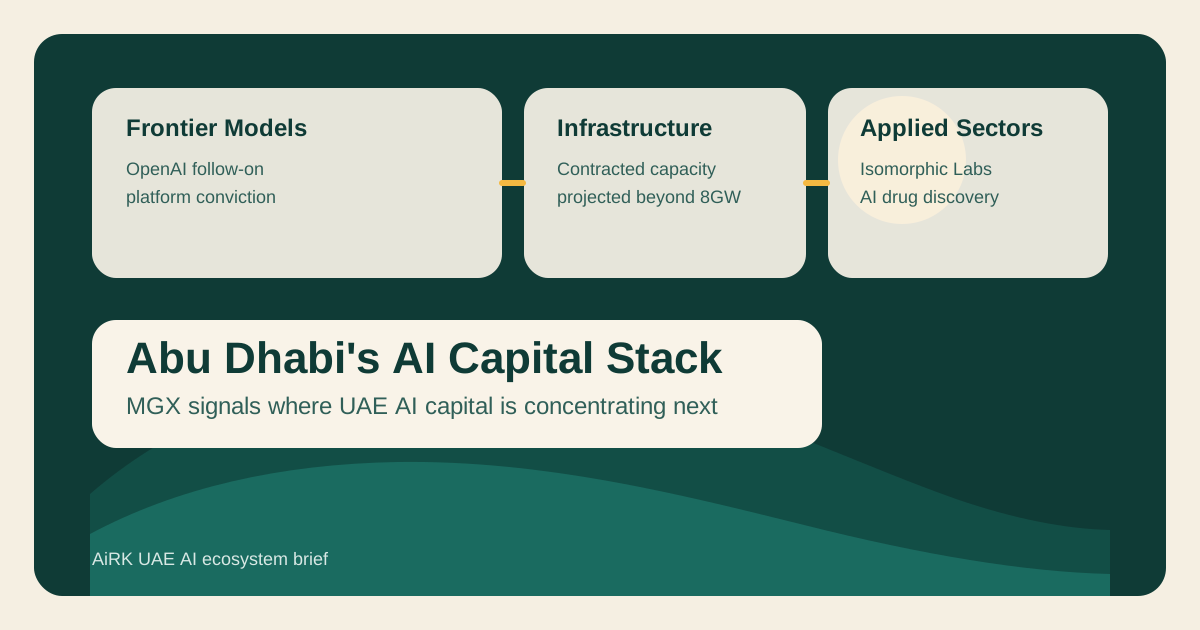
On 25 May 2026, the Abu Dhabi Media Office said MGX reviewed a portfolio that is expanding "across the entire AI tech stack" at its second board meeting of the year. The examples matter. MGX highlighted participation as co-lead in OpenAI's latest US$122 billion funding round, its first investment in AI drug discovery through Isomorphic Labs' US$2.1 billion Series B, and infrastructure capacity across portfolio companies projected to exceed 8 gigawatts by the end of 2026.
That combination is a useful UAE market signal. Abu Dhabi is not placing its AI bets in one layer only. It is backing models, infrastructure, and sector applications at the same time.
The direct answer
This matters because it shows the UAE AI market is becoming more capital-structured and more specialised.
For professionals, leaders, enterprise teams, and government operators, the implication is straightforward:
- AI opportunity in the UAE is spreading beyond chat interfaces into compute, regulated deployment, and sector-specific workflows
- local organizations will face rising expectations to understand where they fit in the stack, not just whether they are "using AI"
- AI capability-building now needs to include investment logic, implementation constraints, governance, and industry use-case design
In short, Abu Dhabi's capital is helping define what serious AI readiness looks like in the next phase of the market.
What MGX actually signalled
The 25 May 2026 update is important less because it announced one new product and more because it showed the pattern of Abu Dhabi's AI positioning.
According to the Abu Dhabi Media Office, MGX reviewed:
- its co-lead role in OpenAI's latest funding round
- its first investment in AI-enabled drug discovery through Isomorphic Labs
- infrastructure expansion projected to exceed 8GW of contracted capacity by the end of 2026
Taken together, those are three different bets.
The first is a frontier-model bet. The second is an applied vertical bet in life sciences. The third is an infrastructure and capacity bet. That breadth matters because it suggests Abu Dhabi is trying to participate in the economics of AI across the full chain rather than only consuming external tools downstream.
That is a stronger strategic position than simply buying software licenses or celebrating pilot launches.
Why this is different from a normal funding headline
Many AI funding stories are easy to overread. One investor joins a large round, the market generates buzz, and very little changes on the ground.
This case is more useful because the board update sits inside a wider Abu Dhabi pattern.
MGX describes its own strategy as covering semiconductors, AI infrastructure, and AI technology. Earlier in 2026, the firm had already discussed follow-on positions in Anthropic, xAI, Databricks, and OpenAI, along with progress on its AI Infrastructure Partnership. The new May board update adds two more useful details: stronger emphasis on infrastructure scale and a move into AI drug discovery through Isomorphic Labs.
That broadening matters for the UAE market because it increases the chance that local demand will deepen in adjacent categories:
- infrastructure and data-centre delivery
- governance and risk functions around AI deployment
- industry partnerships in healthcare, energy, finance, and public services
- technical and non-technical talent able to operate around production AI systems
The key point is simple: when capital spreads across the stack, the surrounding execution market usually expands too.
Why the Isomorphic Labs angle matters for the UAE
The Isomorphic Labs detail is easy to miss, but it may be one of the most practical signals in the whole announcement.
AI drug discovery is not a generic productivity use case. It sits inside a high-trust, research-heavy, and regulated environment. By joining Isomorphic Labs' Series B, MGX is not just backing AI in the abstract. It is backing an application area where AI must prove scientific usefulness, not only consumer adoption.
That is relevant for Abu Dhabi because the emirate has already been building AI credibility in healthcare and life sciences. The Department of Health - Abu Dhabi's recent intelligent surgical network launch is one example. An MGX move into AI drug discovery suggests that Abu Dhabi's AI ecosystem is becoming more comfortable operating in high-value verticals where accuracy, governance, and institutional partnerships matter.
For UAE professionals, that shifts the opportunity set. The market will increasingly value people who can connect AI with domain-specific operating environments, especially where compliance, evidence, and expert oversight are non-negotiable.
Why infrastructure scale still matters just as much
The board's infrastructure update is equally important.
The Abu Dhabi Media Office said MGX portfolio companies are projected to exceed 8GW of contracted capacity by the end of 2026. That does not mean all of that capacity instantly becomes local enterprise compute available to every UAE team. It would be too strong to claim that.
But it does reinforce a practical direction: Abu Dhabi-linked capital continues to treat AI infrastructure as a strategic asset class, not a background utility.
That matters because the UAE market is now dealing with more specific deployment questions:
- Which workloads need sovereign or tightly governed environments?
- Which sectors can rely on shared commercial tooling, and which cannot?
- Where do data residency, security controls, and export-compliance realities shape architecture choices?
- Which teams can actually translate compute access into useful operational systems?
Capital can help build the first layer. It does not solve the last one automatically. That remains a workforce and operating-model problem.
What leaders in the UAE should do with this signal
The practical mistake would be to read the MGX update as a story only for investors.
It is more useful as a market-planning signal.
If Abu Dhabi's AI capital is moving across models, infrastructure, and applied sectors, then UAE organizations should stop treating AI as one generic budget line. A better response would be:
- Decide which layer of the AI stack matters most to your organization in the next 12 to 24 months.
- Separate experimentation goals from production goals.
- Identify which workflows could become strategically important if AI capability in your sector gets cheaper, faster, or more regulated.
- Train managers and operators to evaluate AI systems in terms of process design, controls, and measurable outcomes, not only model novelty.
This is especially important for enterprise functions and government teams that work in procurement, healthcare, finance, operations, compliance, or citizen services. Those functions will feel the effects of AI capital allocation long before they feel the effects of another viral demo.
The workforce implication for AiRK's audience
For AiRK's audience, the main lesson is that market value is shifting toward translation skills.
The most useful AI professional in the UAE is not just the person who follows funding headlines or tries the newest model first. It is the person who can help an organization answer practical questions such as:
- which use cases deserve investment now
- what governance is needed before deployment
- which data, tooling, and process constraints will block adoption
- where AI is a productivity layer versus a strategic capability layer
That is why role-based training matters. As the UAE ecosystem becomes more sophisticated, organizations need people who can connect AI tools to sector workflows, budget decisions, risk thresholds, and implementation plans.
AiRK view for the UAE market
MGX's latest board update is a strong Abu Dhabi signal that the UAE AI ecosystem is maturing across the full capital stack.
The message is not that every organization should suddenly act like a venture investor. It is that serious AI markets are shaped by what gets financed, what gets built, and which sectors are judged important enough for long-term deployment.
Right now, Abu Dhabi appears to be concentrating on all three.
For UAE leaders and professionals, that means AI readiness should become more specific. The next winners are likely to be teams that understand where they sit in the stack, which use cases matter most in their sector, and what capabilities they need to move from interest to execution.