
Dubai's AI Integration Matrix turns government AI into an operating model
Digital Dubai's 28 April 2026 AI Integration Matrix Framework is a practical UAE signal: serious AI adoption now needs use-case classification, data discipline, infrastructure readiness, and role-based execution.
One of the most useful Dubai AI developments this spring was not a new model launch. It was a framework.
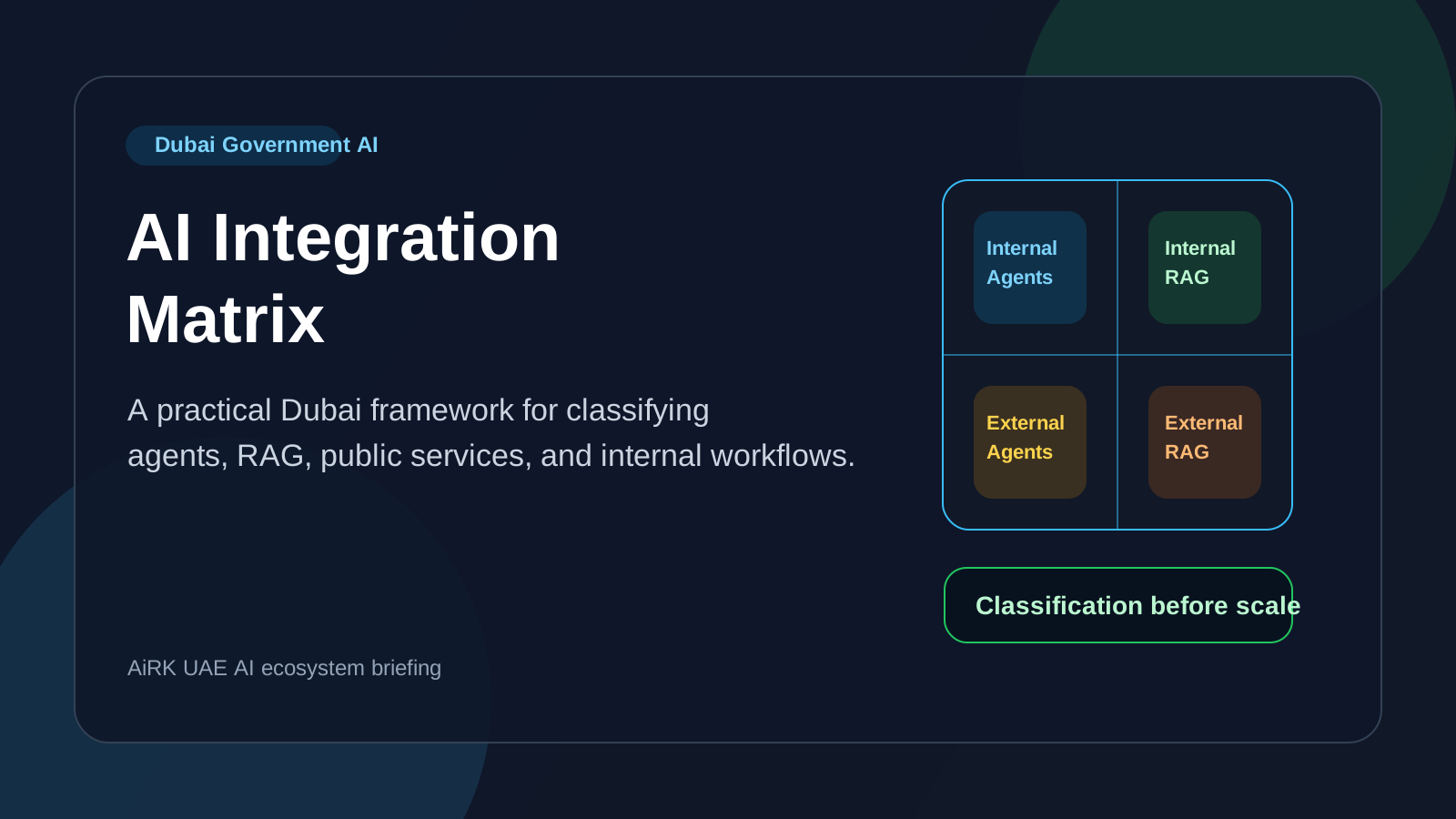
On 28 April 2026, Digital Dubai released its AI Integration Matrix Framework for Government Organizations, a whitepaper designed to help Dubai Government entities classify AI use cases, prioritize them, and build them inside a more integrated operating model. The framework groups AI initiatives into four practical categories: internal agents, internal retrieval-augmented generation (RAG), external agents, and external RAG.
That matters because it gives the UAE market something many AI programs still lack: a clearer way to decide what kind of AI system an organization is actually trying to build.
The direct answer
Dubai's AI Integration Matrix matters because it shifts the conversation from AI enthusiasm to AI portfolio design.
For professionals, leaders, enterprise teams, and government departments, the implication is straightforward:
- AI adoption should be mapped by workflow type, not treated as one undifferentiated program
- data quality, integration, and governance need to be designed before scaling
- role-based execution matters more than broad "AI transformation" messaging
In other words, the next maturity test is not whether an organization has AI pilots. It is whether it can place those pilots into a coherent operating model.
What Digital Dubai actually introduced
According to Digital Dubai and the Government of Dubai Media Office, the framework was created to help government entities move from fragmented experimentation toward a coordinated ecosystem. The practical model is simple enough to be useful:
- internal agents for operational workflows and efficiency
- internal RAG systems for institutional knowledge access and decision support
- external agents for interactive public or customer-facing services
- external RAG systems for information and knowledge delivery to the public
That classification is more important than it may first appear. Many organizations still bundle very different AI projects under one label, even though each type has different requirements for data access, review rules, integration effort, and risk control.
Digital Dubai also said the framework has already been applied internally to guide deployment of more than 100 AI systems across multiple sectors. That does not automatically prove every organization can reproduce the same result. But it does make the framework more credible than a generic thought-leadership document.
Why this is a useful UAE market signal
The strongest part of the announcement is not the matrix diagram itself. It is the operating logic underneath it.
The framework explicitly emphasizes that successful AI implementation depends on data quality, governance, system integration, and infrastructure readiness, not only on model selection. That is a practical correction to a common market mistake. Too many AI programs still begin with tool demos and only later ask:
- Which systems will this connect to?
- Which data is reliable enough to use?
- Which outputs need mandatory review?
- Which team actually owns the workflow after launch?
Dubai is effectively signaling that AI maturity depends on answering those questions early.
That fits the emirate's broader direction. On 1 April 2026, Sheikh Hamdan directed Dubai government entities to integrate individual and business services into a unified digital platform within one year, with Digital Dubai coordinating implementation. On 15 April 2026, Digital Dubai launched AI+, a workforce initiative to train 50,000 government employees through role-based tracks. The matrix framework sits naturally between those two moves: integrated digital services need a clearer AI architecture, and that architecture needs people trained to run it.
What leaders should take from the four quadrants
The most practical value of the matrix is that it encourages leaders to stop treating all AI use cases as equally ready.
For example:
- an internal RAG system may be a strong early step when knowledge is scattered but the workflow is still human-led
- an internal agent may make sense when a process is repetitive, rules-heavy, and already well documented
- an external RAG system may help improve public information access before a department is ready for a transactional external agent
- an external agent may require the highest bar for review, escalation, and service design because it directly affects the public experience
This is a better way to sequence adoption than simply asking which department wants AI first.
What enterprises and government teams should do now
Even though the framework was published for government organizations, the logic travels well into enterprise settings in the UAE and GCC.
A practical response would be:
- List current and proposed AI use cases.
- Sort each one into a category such as internal agent, internal RAG, external agent, or external knowledge service.
- Check whether the data, systems, and process ownership needed for that category actually exist.
- Train the team differently depending on the category rather than giving everyone the same AI guidance.
That matters because the skills are different. A team building internal knowledge retrieval needs document quality, permissions, and search design. A team building an external agent needs service design, exception handling, auditability, and escalation rules. Treating both as the same "AI project" usually creates friction later.
The workforce implication for AiRK's audience
For AiRK's audience, this announcement is a reminder that the valuable AI professional is increasingly the person who can structure adoption, not only prompt a model well.
That means building capability in areas such as:
- workflow mapping
- use-case prioritization
- data and policy boundaries
- human review design
- category-specific implementation habits
This is especially relevant for government teams, regulated sectors, and enterprise functions that want repeatable AI outcomes rather than scattered wins.
AiRK view for the UAE market
Dubai's AI Integration Matrix is a useful contribution to the UAE ecosystem because it makes AI planning more operational. It gives teams a clearer way to classify use cases, stage adoption, and connect governance with delivery.
The main lesson is simple: not every AI project should start the same way, and not every team needs the same training.
Organizations that adopt that mindset will usually scale faster and with less confusion than organizations that treat AI as one giant, undefined transformation program.
Sources
- Digital Dubai launches AI Integration Matrix Framework to accelerate AI adoption across government
- AI Integration Matrix Framework for Government Organizations
- Government of Dubai Media Office: Digital Dubai launches AI Integration Matrix Framework to accelerate AI adoption across government
- Government of Dubai Media Office: Digital Dubai Launches AI+ to Build an AI-Ready Government Workforce
- Government of Dubai Media Office: Hamdan bin Mohammed directs Dubai government entities to integrate all individual and business services into a unified digital platform